Industrial Hydropower ROI Modeling and Financing in 2026
Industrial Hydropower ROI Modeling and Financing in 2026
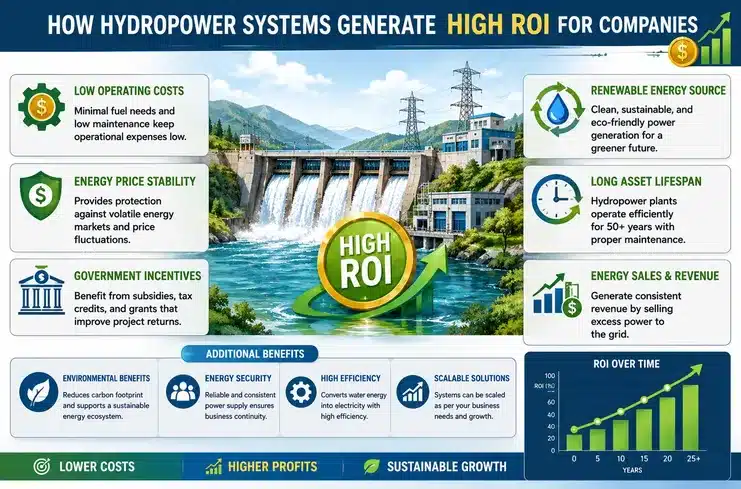
Hydropower projects require significant upfront capital, but their long operating life and low fuel cost create attractive returns. In 2026, industrial developers across the USA, UK, Germany, Netherlands, Italy, and France are using structured ROI models to justify investments and secure financing.
This guide explains how to build a hydropower ROI model, compare financing options, and evaluate risks for industrial-scale projects.
Table of Contents
- Building a Hydropower ROI Model
- Revenue and Savings Components
- Cost Structure and Lifecycle Analysis
- Financing Options
- Incentives and Tax Considerations
- Sensitivity and Risk Analysis
- Regional ROI Examples
- Frequently Asked Questions
Building a Hydropower ROI Model
A robust ROI model forecasts cash flows over the project life, typically 25 to 50 years. It should include capital costs, operating costs, energy production, revenue, incentives, and financing costs.
Core Model Inputs
- Installed capacity and capacity factor
- Capital cost per kilowatt
- Annual O&M cost
- Electricity price or avoided cost
- Incentive values and duration
- Debt terms and tax assumptions
Revenue and Savings Components
Self-Consumption Savings
Industrial facilities save money by displacing grid purchases. Savings equal the volume of self-generated energy multiplied by the avoided retail or wholesale price.
Export Revenue
Selling surplus power to the grid adds revenue. Feed-in tariffs provide fixed prices, while merchant sales expose the project to market volatility.
Renewable Energy Certificates
Renewable energy certificates, green certificates, or guarantees of origin provide additional revenue in some markets.
Cost Structure and Lifecycle Analysis
| Cost Category | Typical Range | Notes |
|---|---|---|
| Civil works | 30% - 60% of capital | Varies with site conditions |
| Electromechanical | 25% - 45% of capital | Turbine, generator, controls |
| Grid connection | 5% - 20% of capital | Higher for remote sites |
| Soft costs | 10% - 20% of capital | Permitting, legal, engineering |
| Annual O&M | 1% - 3% of capital | Lower than thermal plants |
Financing Options
Corporate Balance Sheet
Large industrial companies may fund projects internally. This avoids financing fees but ties up capital.
Project Finance
Project finance uses the project's cash flows to repay debt. It is common for larger developments and limits recourse to the parent company.
Green Bonds and Sustainable Loans
Green bonds offer favorable terms for renewable projects. European manufacturers increasingly use sustainability-linked loans tied to environmental KPIs.
Equipment Leasing
Leasing electromechanical equipment preserves capital. This option suits companies that prefer operational expenditures over capital expenditures.
Incentives and Tax Considerations
Available incentives vary by country. The USA offers investment tax credits and depreciation benefits. Germany and France support small hydro through feed-in tariffs. The UK provides smart export guarantees. Italy and the Netherlands offer various green transition incentives.
Sensitivity and Risk Analysis
ROI models should test sensitivity to key variables. Hydrological risk, electricity price changes, and construction cost overruns are the most common risks.
Regional ROI Examples
A 2 MW run-of-river project in France might achieve a 10% unlevered IRR with a 12-year payback. A similar project in the USA with tax credits could achieve a 14% levered IRR with an 8-year payback. UK projects with long-term power purchase agreements often show stable but lower returns.
Frequently Asked Questions
What is a good IRR for hydropower?
Unlevered IRRs of 8% to 12% are common for small hydro in developed markets. Levered returns can be higher with favorable debt and tax treatment.
How long is the payback period?
Payback periods typically range from 6 to 15 years for small run-of-river projects, depending on site economics and incentives.
What is the biggest financial risk?
Hydrological risk and construction cost overruns are typically the largest financial risks. Conservative flow estimates and fixed-price contracts help mitigate these.
Can hydropower qualify for green financing?
Yes. Hydropower projects often qualify for green bonds, sustainable loans, and development bank financing, especially run-of-river designs.
Should projects use debt or equity?
Debt improves equity returns when project cash flows are stable. The optimal leverage depends on revenue certainty and lender requirements.
How do tax credits affect ROI?
Tax credits can significantly improve ROI by reducing upfront capital or providing tax shelter over time. They should be modeled carefully with tax advisors.
What is the typical project life assumption?
Financial models typically assume 25 to 40 years, though hydropower assets can operate much longer with proper maintenance.
Conclusion
Hydropower ROI modeling requires careful attention to revenue, costs, financing, and risk. Industrial developers that build realistic models and secure appropriate financing can achieve attractive long-term returns.
Across the USA, UK, Germany, Netherlands, Italy, and France, 2026 presents favorable conditions for well-structured hydropower investments supported by green finance and industrial energy demand.
Comments (3)