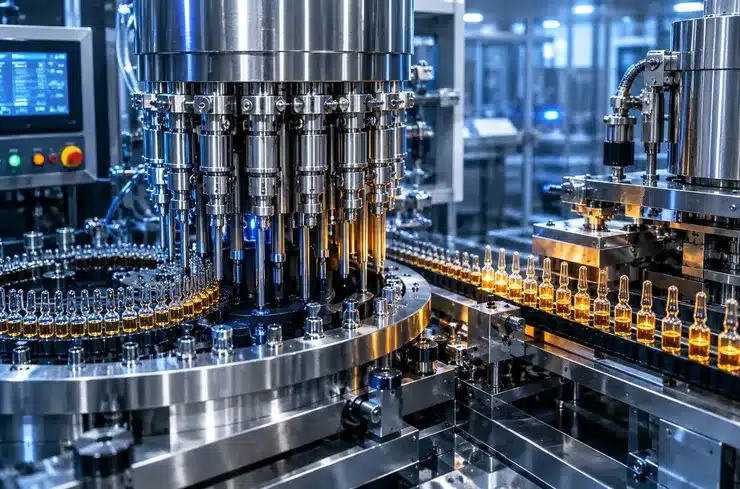
High-Speed Ampoule Filling Line Design and Throughput Optimization 2026
High-Speed Ampoule Filling Line Design and Throughput Optimization 2026
High-speed ampoule filling lines are critical assets for pharmaceutical companies supplying injectable therapies in large volumes. In 2026, manufacturers across the United States, United Kingdom, Germany, Netherlands, Italy, and France are redesigning these lines to increase throughput, reduce changeover time, and maintain stringent aseptic standards. Balancing speed with quality requires careful attention to line layout, equipment selection, process control, and contamination prevention.
This guide explores how to design and optimize high-speed ampoule filling lines for modern pharmaceutical production. It covers engineering principles, operational strategies, and regulatory considerations that influence line performance.
Table of Contents
- Drivers of High-Speed Ampoule Filling
- Line Configuration and Layout
- Filling Pump Technologies
- Contamination Control Strategies
- Changeover and Format Flexibility
- In-Process Inspection
- Regulatory and GMP Considerations
- Throughput Optimization Techniques
- Total Cost of Ownership
- Frequently Asked Questions
Drivers of High-Speed Ampoule Filling
Growing demand for biologics, vaccines, and generic injectables is pushing fill-finish facilities toward higher throughput. At the same time, regulatory expectations for sterility assurance and data integrity continue to rise. High-speed lines must therefore deliver more units per hour without increasing contamination risk or quality variability.
Line Configuration and Layout
Linear vs Rotary Layouts
Linear layouts are simpler and easier to access for maintenance. Rotary layouts offer higher speeds and smaller footprints but require more sophisticated synchronization.
Barrier Technology Integration
Restricted access barrier systems and isolators separate operators from the aseptic core. Layout decisions must accommodate airflow patterns, intervention points, and material transfer airlocks.
Material Flow
Unidirectional material flow prevents mix-ups and contamination. WIP buffers should be minimized to reduce hold times and simplify traceability.
Filling Pump Technologies
Peristaltic pumps, piston pumps, and time-pressure systems each offer different advantages. Peristaltic pumps reduce cross-contamination risk because the fluid contacts only disposable tubing. Piston pumps provide high accuracy for viscous products. Time-pressure systems offer simplicity and fast changeover.
Contamination Control Strategies
High-speed operation increases the importance of environmental control. Continuous particle and viable monitoring, automated disinfection cycles, and validated stopper and cap handling systems maintain aseptic conditions. First air principles must be preserved at all open product zones.
Changeover and Format Flexibility
Modern lines must handle multiple ampoule sizes and products with minimal downtime. Quick-change format parts, recipe-driven control systems, and pre-staged tooling reduce changeover intervals. Some German and Dutch facilities achieve changeovers in under two hours.
In-Process Inspection
Automated inspection systems check fill volume, container integrity, particle contamination, and cosmetic defects. Machine vision and laser-based leak detection operate at line speed and provide statistical data for process control.
Regulatory and GMP Considerations
High-speed lines must comply with FDA, EMA, and MHRA expectations for sterile manufacturing. Validation includes installation qualification, operational qualification, performance qualification, and process simulation with media fills. Data integrity requirements apply to all computerized systems.
Throughput Optimization Techniques
| Technique | Impact |
|---|---|
| Reduce reject rates | More good units per hour |
| Improve changeover efficiency | More productive hours per day |
| Optimize line balancing | Eliminate bottlenecks |
| Predictive maintenance | Reduce unplanned stops |
| Operator training | Faster recovery from minor stoppages |
Total Cost of Ownership
Capital cost is only one component of line economics. Utilities, consumables, validation, maintenance, and regulatory compliance contribute significantly to lifetime cost. Energy-efficient drives and optimized cleanroom footprints reduce ongoing operating expenses.
Future Trends and Regional Considerations
Continuous Manufacturing Integration
As manufacturers pursue high speed ampoule machines, Continuous Manufacturing Integration has emerged as a key enabler. It helps teams overcome traditional constraints and respond faster to changing market demands.
Facilities in the United States, Germany, and the United Kingdom demonstrate that Continuous Manufacturing Integration can deliver practical value in high speed ampoule machines without requiring massive capital outlays. Scalable deployment models are helping smaller players participate.
Robotic Aseptic Processing
Robotic Aseptic Processing represents a significant evolution in high speed ampoule machines. Organizations that master this area can differentiate their offerings and build more resilient operations.
Markets such as the United States, the Netherlands, and Germany show strong momentum for Robotic Aseptic Processing adoption. Local regulations, customer requirements, and competitive pressure all contribute to this growth.
Adaptive Process Control
Adaptive Process Control represents a significant evolution in high speed ampoule machines. Organizations that master this area can differentiate their offerings and build more resilient operations.
Organizations in the United Kingdom, the Netherlands, and Italy are integrating Adaptive Process Control into their operations to reduce risk, lower costs, and improve outcomes. In 2026, this trend is accelerating as digital tools, tighter regulations, and customer expectations drive investment.
Frequently Asked Questions
How fast can ampoule filling lines run?
Modern high-speed lines can fill 400 or more ampoules per minute, depending on fill volume, product characteristics, and inspection requirements.
What limits line speed?
Speed is limited by filling accuracy, environmental control, inspection capability, and the mechanical handling of fragile glass containers.
How is sterility maintained at high speed?
Sterility is maintained through isolator or RABS technology, unidirectional airflow, rigorous environmental monitoring, and validated aseptic techniques.
What is the typical payback for a high-speed line?
Payback depends on product volume and margin, but high-speed lines often achieve payback within three to five years for blockbuster products.
Can high-speed lines handle multiple products?
Yes, with proper changeover procedures, cleaning validation, and dedicated product contact parts where needed.
Conclusion
High-speed ampoule filling line design demands a systems approach that integrates engineering, quality, and regulatory expertise. In 2026, successful facilities will combine advanced filling technology, robust contamination control, and data-driven optimization to meet growing demand while maintaining the highest standards of patient safety.
Comments (3)