Heat Treatment Furnace Selection for Metalworking Shops 2026
Heat Treatment Furnace Selection for Metalworking Shops 2026
Heat treatment defines the mechanical properties, dimensional stability, and service life of metal components. For metalworking shops in the United States, United Kingdom, Germany, Netherlands, Italy, and France, selecting the right furnace in 2026 means balancing process requirements, throughput, energy costs, and environmental compliance. The wrong choice leads to inconsistent results, excessive utility bills, and rejected parts.
This guide explains how to evaluate heat treatment furnaces for typical shop environments. It covers process types, furnace architectures, control systems, energy considerations, and selection criteria that help owners make confident capital equipment decisions.
Table of Contents
- Why Furnace Selection Drives Shop Profitability
- Common Heat Treatment Processes
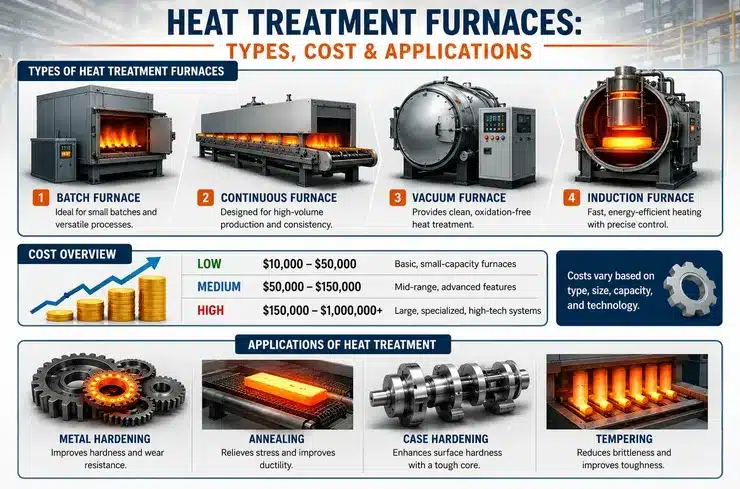
- Furnace Types and Applications
- Temperature Uniformity and Atmosphere Control
- Energy Efficiency and Sustainability
- Safety and Regulatory Compliance
- Maintenance and Reliability
- Cost Factors and ROI
- Regional Supplier Landscape
- Selection Checklist
- Frequently Asked Questions
Why Furnace Selection Drives Shop Profitability
The furnace is often the most energy-intensive asset in a metalworking shop. It also determines whether parts meet hardness, tensile strength, and microstructure specifications. A well-selected furnace reduces rework, lowers energy consumption, and supports diversified work from automotive, aerospace, tooling, and general engineering customers.
In 2026, shops are under additional pressure to document carbon emissions and comply with evolving safety standards. Selecting a furnace with modern controls and efficient insulation helps address both commercial and regulatory demands.
Common Heat Treatment Processes
Hardening and Tempering
Hardening involves heating steel above its critical temperature and rapid cooling, followed by tempering to achieve the desired balance of hardness and toughness. These processes require precise temperature control and rapid quenching systems.
Annealing and Normalizing
Annealing softens material, relieves internal stresses, and improves machinability. Normalizing refines grain structure after forging or casting. Both processes require controlled heating and cooling cycles.
Carburizing and Nitriding
Surface hardening treatments introduce carbon or nitrogen into the surface layer to improve wear resistance. These processes require controlled atmosphere furnaces with precise gas management.
Aging and Solution Treatment
Aluminum and nickel alloys often require solution treatment followed by aging. Accuracy and uniformity are critical because small temperature deviations affect final mechanical properties.
Furnace Types and Applications
Box Furnaces
Box furnaces are versatile and suitable for batch processing of mixed parts. They are common in job shops that handle diverse heat treatment requirements.
Belt and Pusher Furnaces
Continuous furnaces suit high-volume production with consistent part sizes. They offer predictable throughput and reduced labor compared to batch systems.
Pit Furnaces
Pit furnaces handle long or heavy parts that cannot be loaded horizontally. They are widely used for shafts, rolls, and large forgings.
Vacuum Furnaces
Vacuum furnaces prevent oxidation and decarburization without protective atmosphere gases. They are preferred for aerospace, medical, and high-alloy components.
Retort Furnaces
Retort furnaces contain the process atmosphere within a sealed vessel. They are used for controlled atmosphere processes such as carburizing and carbonitriding.
Temperature Uniformity and Atmosphere Control
Temperature uniformity class, defined by standards such as AMS 2750, determines how consistent conditions are throughout the workload. Aerospace and automotive customers often require Class 2 or better. Atmosphere control systems using nitrogen, methanol, or endothermic gas maintain surface chemistry and prevent scaling.
Energy Efficiency and Sustainability
Modern furnaces use low-mass insulation, regenerative burners, and variable speed fans to reduce energy consumption. Waste heat recovery systems preheat combustion air or generate hot water for other processes. German and Dutch shops increasingly specify furnaces with documented carbon footprints to satisfy customer sustainability requirements.
Safety and Regulatory Compliance
Heat treatment shops must comply with safety standards for fire prevention, explosion protection, and gas handling. In Europe, the ATEX directive and Pressure Equipment Directive influence furnace design and operation. In the United States, NFPA codes and OSHA requirements govern installation and maintenance.
Maintenance and Reliability
Reliable furnaces minimize unplanned downtime and protect valuable workloads. Key maintenance items include heating element inspection, thermocouple replacement, door seal condition, and burner tuning. Predictive maintenance using thermal imaging and vibration monitoring is becoming standard practice.
Cost Factors and ROI
| Factor | Impact on Cost | Consideration |
|---|---|---|
| Initial purchase | Capital outlay | Balance specifications with budget and financing options |
| Installation | Foundation, utilities, venting | Assess site readiness before ordering |
| Energy | Largest operating cost | Prioritize insulation and combustion efficiency |
| Consumables | Atmosphere gases, refractory | Estimate annual consumption accurately |
| Maintenance | Downtime and parts | Evaluate local service support |
Regional Supplier Landscape
German furnace manufacturers are known for precision, automation, and energy efficiency. Italian suppliers offer flexible solutions for high-mix shops. US manufacturers provide robust equipment with strong domestic support. UK and Dutch distributors often specialize in integrating furnaces with digital monitoring platforms.
Selection Checklist
- Define required processes, temperature ranges, and uniformity classes.
- Estimate annual throughput and batch sizes.
- Evaluate energy costs and efficiency features.
- Confirm atmosphere and quenching requirements.
- Assess safety, environmental, and zoning compliance.
- Review supplier service coverage and spare parts availability.
- Calculate total cost of ownership over ten years.
Frequently Asked Questions
What type of furnace is best for a small metalworking shop?
A versatile box furnace with programmable controls is usually the best starting point for small shops handling diverse batch work.
How much does a heat treatment furnace cost?
Small box furnaces start around \$15,000. Industrial vacuum and continuous furnaces can exceed \$500,000 depending on size and features.
What temperature uniformity class do I need?
General shop work often accepts Class 5. Aerospace and automotive customers typically require Class 2 or better.
How can I reduce furnace energy consumption?
Improve insulation, tune burners, recover waste heat, reduce idle time, and load furnaces efficiently.
Do I need a vacuum furnace?
Vacuum furnaces are recommended for oxidation-sensitive alloys, aerospace components, and applications requiring bright finishes.
Conclusion
Heat treatment furnace selection is a strategic decision that affects part quality, energy spending, and shop capacity for decades. In 2026, metalworking shops should evaluate furnaces as integrated systems that include controls, atmosphere management, safety features, and service support. A disciplined selection process aligned with process requirements and customer expectations will deliver long-term value.
Comments (3)