Choosing the Right Hydro Turbine Technology for Your Site in 2026
Choosing the Right Hydro Turbine Technology for Your Site in 2026
Not every hydro turbine suits every site. Head, flow, environmental constraints, and project budget all influence the optimal technology choice. In 2026, site-specific turbine selection is becoming more important as developers target smaller, lower-head resources.
This guide walks through the selection process for industrial and community-scale hydro projects across the USA, UK, Germany, Netherlands, Italy, and France.
Table of Contents
- Site Assessment Fundamentals
- Head Classification and Turbine Matching
- Flow Duration Analysis
- Environmental and Permitting Constraints
- Turbine Technology Comparison
- Efficiency Curves and Part-Load Performance
- Site-Specific Selection Framework
- Frequently Asked Questions
Site Assessment Fundamentals
A thorough site assessment includes topographic survey, flow measurement, sediment analysis, and environmental screening. Without reliable data, turbine selection becomes guesswork.
Key Site Parameters
- Gross head and net head
- Minimum, design, and maximum flow
- Flow duration curve
- Water quality and sediment load
- Environmental sensitivities
Head Classification and Turbine Matching
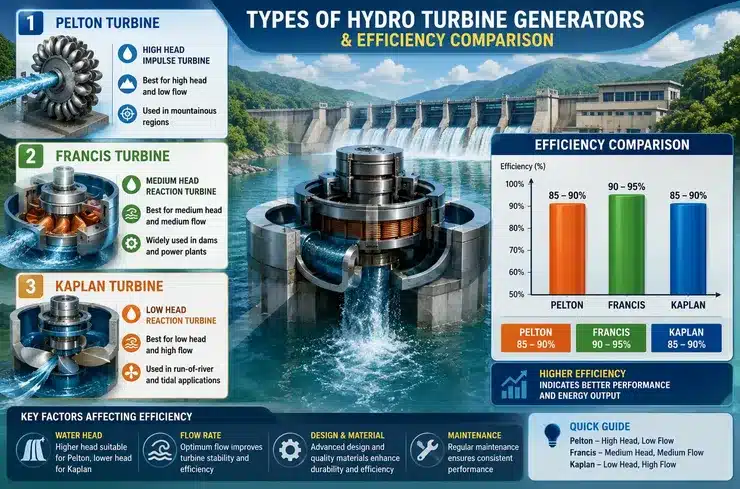
Head is the vertical drop available to the turbine. It is the single most important factor in turbine selection.
| Head Class | Range | Typical Turbines |
|---|---|---|
| High head | Above 100 m | Pelton, Turgo |
| Medium head | 30 m to 100 m | Francis, cross-flow |
| Low head | Below 30 m | Kaplan, propeller, Archimedes screw |
Flow Duration Analysis
The flow duration curve shows how often different flow rates occur. Turbines should be selected for the flow range that produces the most energy over the year, not just the maximum flow.
Environmental and Permitting Constraints
European and North American projects face strict environmental rules. Fish passage, minimum ecological flow, and sediment management affect turbine choice. Archimedes screw turbines are often chosen in the UK and Netherlands for their fish-friendly operation.
Turbine Technology Comparison
| Technology | Efficiency | Flow Flexibility | Environmental Suitability |
|---|---|---|---|
| Pelton | High at design point | Limited | Good with proper design |
| Francis | Very high | Moderate | Requires fish screening |
| Kaplan | High across range | Excellent | Variable depending on design |
| Archimedes screw | Moderate | Good | Excellent fish passage |
| Cross-flow | Moderate | Good | Simple and robust |
Efficiency Curves and Part-Load Performance
Turbine efficiency changes with flow. Francis and Kaplan turbines maintain good efficiency over a wide operating range, making them suitable for variable-flow rivers.
Site-Specific Selection Framework
- Confirm head and flow with field measurements
- Develop the flow duration curve
- Screen environmental constraints
- Short-list turbine types matching head and flow
- Compare energy yield and cost for each option
- Evaluate supplier experience and local support
- Select the technology with the best lifecycle value
Future Trends and Regional Considerations
Pumped Storage Integration
As manufacturers pursue hydro turbine types comparison, Pumped Storage Integration has emerged as a key enabler. It helps teams overcome traditional constraints and respond faster to changing market demands.
In France, Germany, and the Netherlands, engineering teams are using Pumped Storage Integration to solve long-standing challenges in hydro turbine types comparison. The approach is gaining traction among both large enterprises and specialized suppliers.
Fish-Friendly Turbine Designs
As manufacturers pursue hydro turbine types comparison, Fish-Friendly Turbine Designs has emerged as a key enabler. It helps teams overcome traditional constraints and respond faster to changing market demands.
Facilities in Italy, the United States, and the United Kingdom demonstrate that Fish-Friendly Turbine Designs can deliver practical value in hydro turbine types comparison without requiring massive capital outlays. Scalable deployment models are helping smaller players participate.
Modular Micro-Hydro Systems
As manufacturers pursue hydro turbine types comparison, Modular Micro-Hydro Systems has emerged as a key enabler. It helps teams overcome traditional constraints and respond faster to changing market demands.
Organizations in Italy, France, and the United Kingdom are integrating Modular Micro-Hydro Systems into their operations to reduce risk, lower costs, and improve outcomes. In 2026, this trend is accelerating as digital tools, tighter regulations, and customer expectations drive investment.
Frequently Asked Questions
What is the most important factor in turbine selection?
Head is usually the most important factor because it determines which turbine types are technically suitable for the site.
Can one turbine handle both high and low flow?
Kaplan and double-regulated turbines handle flow variation better than fixed-blade designs. Some projects use multiple turbines to cover different flow ranges.
What is the most fish-friendly turbine?
Archimedes screw turbines are widely regarded as fish-friendly due to slow blade speeds and open design.
How does sediment affect turbine choice?
High sediment loads accelerate erosion in Francis turbines. Pelton turbines with hardened nozzles and buckets handle abrasive water better.
What role does part-load efficiency play?
Part-load efficiency matters because turbines rarely operate at design flow. High part-load efficiency increases annual energy yield.
Should I choose a single or multiple turbines?
Multiple smaller turbines improve part-load efficiency and provide redundancy. They cost more upfront but increase operational flexibility.
How do I estimate annual energy output?
Multiply turbine efficiency, head, flow, and operating hours from the flow duration curve. Hydro consultants use specialized software for accurate estimates.
Conclusion
Choosing the right hydro turbine technology requires careful matching of site conditions, environmental requirements, and economic goals. A structured selection process reduces risk and maximizes energy output.
Developers across the USA, UK, Germany, Netherlands, Italy, and France that apply these principles in 2026 will build more reliable and productive hydro projects.
Comments (3)