Hydro Turbine Generator Selection for Remote and Grid-Tied Plants 2026
Hydro Turbine Generator Selection for Remote and Grid-Tied Plants 2026
Choosing the right hydro turbine generator requires matching hydraulic conditions, grid requirements, and operational goals. In 2026, remote industrial sites and grid-tied renewable projects across the USA, UK, Germany, Netherlands, Italy, and France face different priorities for reliability, efficiency, and control.
This selection guide compares turbine and generator combinations for remote off-grid plants, grid-tied installations, and hybrid renewable systems.
Table of Contents
- Turbine and Generator Selection Basics
- Matching Hydraulic Conditions
- Turbine Types for Different Heads
- Generator Technologies Compared
- Remote Off-Grid Considerations
- Grid-Tied Plant Requirements
- Hybrid Hydro-Solar-Battery Systems
- Notable Equipment Suppliers
- Frequently Asked Questions
Turbine and Generator Selection Basics
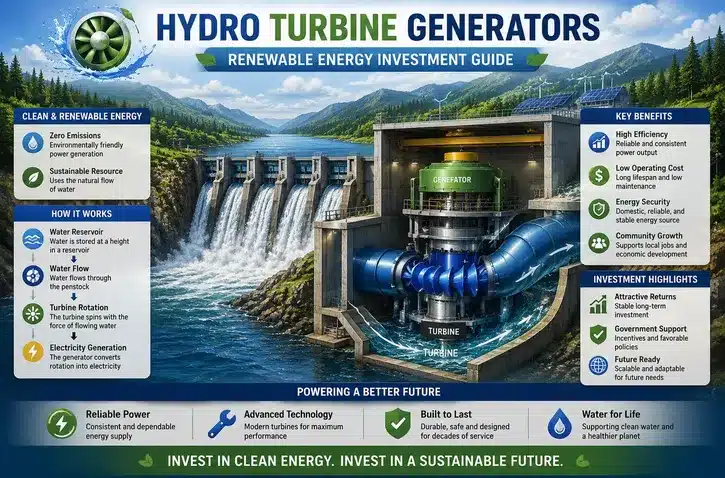
The turbine converts water energy into mechanical rotation. The generator converts that rotation into electricity. Selecting either component in isolation leads to suboptimal performance. The system must be sized as an integrated unit.
Primary Selection Parameters
- Net head in meters
- Design flow rate
- Target electrical output
- Grid or off-grid operation
- Environmental and fish-passage requirements
Matching Hydraulic Conditions
Head and Flow Relationship
Power output depends on head and flow. High-head sites require different turbines than low-head sites, even at the same power level.
Flow Variability
Seasonal flow variation affects turbine selection. Sites with stable flows suit fixed-blade turbines, while variable-flow sites benefit from adjustable designs like Kaplan turbines.
Turbine Types for Different Heads
| Turbine Type | Head Range | Flow Characteristic | Best Application |
|---|---|---|---|
| Pelton | Above 100 m | Low to medium flow | High-head mountain sites |
| Francis | 20 m to 400 m | Medium flow | Medium-head rivers |
| Kaplan | Below 30 m | High flow | Low-head run-of-river |
| Cross-flow | 5 m to 100 m | Variable flow | Small community plants |
Generator Technologies Compared
Synchronous Generators
Synchronous generators produce grid-quality frequency and can provide reactive power. They are common in grid-tied plants above 500 kW.
Asynchronous Generators
Asynchronous generators are simpler and less expensive but require grid connection or capacitors for excitation. They suit small grid-tied systems.
Permanent Magnet Generators
Permanent magnet generators offer high efficiency and compact size. They are popular in small hydro and direct-drive applications.
Remote Off-Grid Considerations
Reliability and Redundancy
Remote sites cannot tolerate long outages. Simple, robust turbine designs with local spare parts availability reduce downtime risk.
Load Management
Off-grid systems need load controllers or battery storage to balance generation and demand. Excess power can be diverted to resistive loads or storage.
Fuel-Free Operation
Hydropower eliminates fuel logistics for remote mines, resorts, and research stations. Italian alpine facilities and Scottish distilleries have used small hydro for decades.
Grid-Tied Plant Requirements
Grid Code Compliance
Grid-tied plants must comply with local grid codes covering frequency, voltage, and fault-ride-through requirements. Germany and the UK have strict codes for distributed generation.
Metering and Revenue
Export metering and power purchase agreements define revenue. Facilities must install approved meters and comply with utility interconnection standards.
Hybrid Hydro-Solar-Battery Systems
Combining hydro with solar and batteries smooths seasonal variation. Hydro provides base load during wet months, while solar and batteries supplement dry periods. This approach is gaining interest in the USA and southern Europe.
Notable Equipment Suppliers
Leading hydro turbine suppliers include Voith, Andritz, GE Renewable Energy, and smaller specialists like Ossberger and TOSHIBA. Generator suppliers include Siemens, ABB, and WEG. Equipment selection should balance technology, service support, and local references.
Frequently Asked Questions
How do I choose between Pelton, Francis, and Kaplan turbines?
Select based on head and flow. Pelton suits high head and low flow, Francis suits medium head and flow, and Kaplan suits low head and high flow.
What generator type is best for off-grid hydro?
Synchronous or permanent magnet generators with battery storage and load control are best for stable off-grid power.
What size turbine do I need?
Size depends on head, flow, and efficiency. A site survey and hydraulic calculation determine the optimal capacity.
Can old hydro sites be refurbished?
Yes. Refurbishing existing sites often costs less than new development and can qualify for heritage or green restoration incentives.
What is the lifespan of a hydro turbine?
Well-maintained turbines can operate 30 to 50 years. Major overhauls are typically needed every 15 to 25 years.
How does grid connection affect generator choice?
Grid-tied plants usually use synchronous generators for grid support. Off-grid plants may use permanent magnet or asynchronous generators with inverters.
Are fish-friendly turbines available?
Yes. Low-head turbines with slow-moving blades and fish-passage designs help comply with environmental regulations in the USA and Europe.
Conclusion
Selecting the right hydro turbine generator requires integrated analysis of hydraulic conditions, electrical requirements, and operational constraints. Remote and grid-tied plants have different priorities, but both benefit from proven technology and experienced suppliers.
Projects across the USA, UK, Germany, Netherlands, Italy, and France that follow a structured selection process in 2026 will achieve higher efficiency, lower risk, and better long-term returns.
Comments (3)