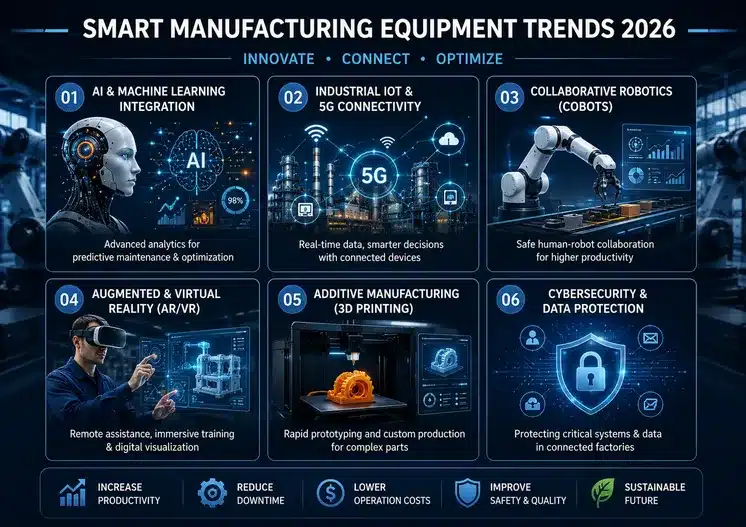
Smart Manufacturing Equipment Roadmap for SME Factories 2026
Smart Manufacturing Equipment Roadmap for SME Factories 2026
Smart manufacturing is no longer reserved for large enterprises with dedicated digital transformation teams. In 2026, small and medium-sized factories across the United States, United Kingdom, Germany, Netherlands, Italy, and France are adopting connected equipment, edge analytics, and cloud-based manufacturing applications at unprecedented rates. The challenge for SMEs is prioritizing investments that deliver quick wins while building capabilities for long-term competitiveness.
This roadmap provides a practical pathway for SME factories to modernize their equipment and operations. It focuses on proven technologies, realistic implementation steps, and common pitfalls to avoid.
Table of Contents
- Defining Smart Manufacturing for SMEs
- Connectivity and IoT Foundations
- Edge Computing and Data Analytics
- Predictive Maintenance Systems
- Collaborative Robotics and Automation
- Digital Twins and Simulation
- MES and ERP Integration
- Workforce Upskilling Requirements
- Cybersecurity Considerations
- Investment Prioritization Framework
- Regional Adoption Patterns
- Frequently Asked Questions
Defining Smart Manufacturing for SMEs
Smart manufacturing uses connected data, analytics, and automation to improve productivity, quality, and responsiveness. For SMEs, the goal is not to create a fully lights-out factory overnight. Instead, it means making incremental improvements that compound over time.
Key pillars include visibility into machine performance, predictive rather than reactive maintenance, automated data collection, and integration between shop floor and business systems. Each pillar builds on the previous one, creating a foundation for more advanced capabilities.
Connectivity and IoT Foundations
Machine Data Collection
Older machines can be retrofitted with sensors for vibration, temperature, power, and cycle counts. Newer equipment often supports protocols such as OPC UA, MQTT, or MTConnect for direct data extraction.
Network Infrastructure
Reliable industrial networking separates operational technology from office IT while enabling secure data flow. Switched Ethernet and industrial Wi-Fi are common starting points.
Cloud and Edge Gateways
Edge gateways collect and preprocess data before sending it to cloud platforms. This reduces bandwidth costs and allows local decision-making even when internet connectivity is limited.
Edge Computing and Data Analytics
Edge computing processes data close to the source, enabling real-time dashboards, alerts, and control decisions. SMEs use edge analytics to track OEE, identify bottlenecks, and monitor energy consumption. German and Dutch manufacturers are particularly advanced in deploying edge devices for shop-floor visualization.
Predictive Maintenance Systems
Predictive maintenance combines sensor data with machine learning to forecast failures before they occur. For SMEs, this means fewer emergency repairs, lower spare parts inventory, and extended equipment life. Common starting points include motors, pumps, compressors, and CNC machines.
Collaborative Robotics and Automation
Collaborative robots, or cobots, work alongside humans without extensive guarding. They are affordable, programmable, and well-suited for machine tending, assembly, inspection, and packaging. UK and Italian SMEs use cobots to address labor shortages and improve consistency.
Digital Twins and Simulation
A digital twin is a virtual model of a physical asset or process. For SMEs, even simple simulation models help optimize layouts, test production schedules, and validate automation concepts before committing capital. Software vendors now offer low-cost simulation tools designed for smaller manufacturers.
MES and ERP Integration
Manufacturing execution systems bridge the gap between enterprise resource planning and the shop floor. They track work orders, collect quality data, and enforce routings. Cloud-based MES solutions reduce IT overhead and scale with business growth.
Workforce Upskilling Requirements
Technology investments fail when operators and maintenance staff lack the skills to use them. SMEs should budget for training in data literacy, basic programming, troubleshooting connected systems, and interpreting analytics dashboards. French and German vocational training programs provide useful models.
Cybersecurity Considerations
Connecting equipment increases exposure to cyber threats. SME factories need basic security practices including network segmentation, strong authentication, regular patching, and employee awareness training. Ignoring security can lead to production disruptions and data breaches.
Investment Prioritization Framework
| Priority | Initiative | Expected Payback |
|---|---|---|
| 1 | Machine monitoring and OEE dashboards | 3 to 6 months |
| 2 | Predictive maintenance on critical assets | 6 to 12 months |
| 3 | Cobot deployment for repetitive tasks | 12 to 24 months |
| 4 | MES and ERP integration | 12 to 36 months |
| 5 | Digital twin and advanced analytics | 24 to 48 months |
Regional Adoption Patterns
German SMEs lead in machine connectivity and standards adoption through initiatives like Industrie 4.0. US manufacturers prioritize scalable cloud platforms and cobot applications. UK factories focus on productivity improvements driven by labor shortages. Dutch companies emphasize supply chain integration and sustainability tracking. Italian and French SMEs invest in flexible automation for high-mix production.
Future Trends and Regional Considerations
Low-Code Manufacturing Apps
Low-Code Manufacturing Apps represents a significant evolution in smart manufacturing equipment. Organizations that master this area can differentiate their offerings and build more resilient operations.
Companies in Italy, the United States, and the United Kingdom report meaningful gains after embedding Low-Code Manufacturing Apps into smart manufacturing equipment workflows. These improvements span productivity, quality, and environmental performance.
5G Shop Floor Connectivity
The adoption of 5G Shop Floor Connectivity within smart manufacturing equipment is accelerating as companies seek measurable improvements. This shift reflects broader industry pressures around cost, quality, and sustainability.
Organizations in Italy, France, and the United Kingdom are integrating 5G Shop Floor Connectivity into their operations to reduce risk, lower costs, and improve outcomes. In 2026, this trend is accelerating as digital tools, tighter regulations, and customer expectations drive investment.
Digital Performance Scorecards
Digital Performance Scorecards is reshaping how organizations approach smart manufacturing equipment. It addresses critical performance gaps while creating opportunities for efficiency, compliance, and competitive differentiation.
Companies in Germany, France, and the United States report meaningful gains after embedding Digital Performance Scorecards into smart manufacturing equipment workflows. These improvements span productivity, quality, and environmental performance.
Frequently Asked Questions
What is the first step in smart manufacturing for an SME?
Start with machine monitoring to establish baseline performance and identify the biggest improvement opportunities.
How much does smart manufacturing equipment cost?
Basic monitoring kits start at a few hundred dollars per machine. Full MES and predictive maintenance deployments can range from \$50,000 to \$500,000 depending on scale.
Do I need to replace old machines?
No. Most older machines can be retrofitted with sensors and gateways to capture useful data.
How do I justify smart manufacturing investments?
Focus on measurable outcomes such as reduced downtime, improved OEE, lower scrap, and labor savings. Pilot projects help build confidence and refine business cases.
What skills do employees need?
Employees need data literacy, basic troubleshooting of connected systems, and the ability to act on analytics insights. Training should be continuous and role-specific.
Conclusion
Smart manufacturing offers SME factories a clear path to higher productivity, better quality, and greater resilience. In 2026, the key is to start with practical, high-impact initiatives and build capabilities progressively. By focusing on connectivity, predictive maintenance, collaborative automation, and workforce development, smaller manufacturers can compete effectively in increasingly digital supply chains.
Comments (3)