GMP Compliance Roadmap for Ampoule Filling Operations 2026
GMP Compliance Roadmap for Ampoule Filling Operations 2026
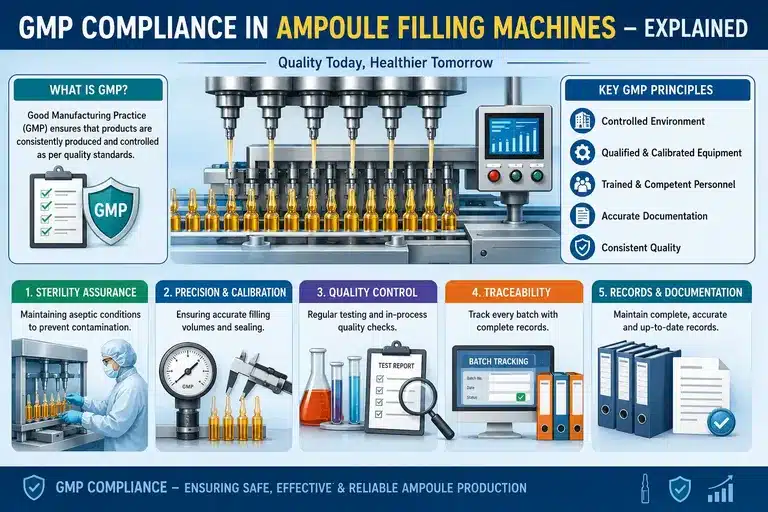
Ampoule filling remains one of the most sensitive operations in pharmaceutical manufacturing. Because these small glass containers hold injectable or ophthalmic products, any deviation from Good Manufacturing Practice can compromise patient safety, trigger regulatory action, and destroy brand trust. In 2026, regulators in the United States, European Union, United Kingdom, and other major markets continue to tighten expectations around data integrity, contamination control, and process validation.
This roadmap provides a structured approach to GMP compliance specifically for ampoule filling lines. It covers facility design, equipment qualification, process validation, documentation practices, and emerging technologies that help manufacturers stay ahead of inspectors.
Table of Contents
- Why GMP Compliance Remains Non-Negotiable in 2026
- Key Regulatory Frameworks Across Regions
- Facility and Environmental Controls
- Equipment Qualification Protocols
- Process Validation and Documentation
- Sterility Assurance and Contamination Control
- Data Integrity and ALCOA+ Principles
- Personnel Training and Hygiene Programs
- Inspection Readiness and CAPA Management
- Technology Trends Supporting GMP Compliance
- Cost of Compliance vs Cost of Non-Compliance
- Frequently Asked Questions
Why GMP Compliance Remains Non-Negotiable in 2026
Regulatory agencies now share inspection data more freely through mutual recognition agreements. A warning letter issued by the FDA can affect product approvals in Europe, and deficiencies found by EMA inspectors can influence MHRA decisions in the United Kingdom. This interconnected enforcement environment makes compliance a global imperative rather than a regional checkbox.
Beyond regulatory pressure, compliance failures create direct financial damage. Product recalls, blocked shipments, and remediation projects can cost millions. For contract manufacturers, a single failed audit can result in lost business from major pharmaceutical sponsors who expect flawless GMP performance.
Key Regulatory Frameworks Across Regions
FDA 21 CFR Parts 210 and 211
These regulations govern pharmaceutical manufacturing in the United States. They emphasize written procedures, validated processes, and complete batch records for every filled ampoule lot.
EudraLex Volume 4 EU GMP Guidelines
The European Union's GMP guide includes Annex 1, which details sterile manufacturing requirements. The 2022 revision places greater emphasis on contamination control strategy and barrier technologies.
MHRA GMP Requirements
The UK Medicines and Healthcare products Regulatory Agency maintains GMP expectations aligned with EU standards while introducing post-Brexit registration and inspection procedures.
WHO GMP and ICH Q9/Q10
World Health Organization guidelines and International Council for Harmonisation documents provide quality risk management and pharmaceutical quality system frameworks used by inspectors worldwide.
Facility and Environmental Controls
Cleanroom Classification
Ampoule filling for sterile products typically occurs in Grade A environments with Grade B backgrounds. Continuous particle monitoring and viable monitoring programs must demonstrate environmental control throughout operations.
HVAC and Pressure Cascades
Heating, ventilation, and air conditioning systems maintain pressure differentials that prevent contamination from adjacent areas. Regular filter integrity testing and airflow visualization studies confirm continued performance.
Barrier and Isolator Technology
Restricted access barrier systems and isolators provide superior separation between operators and product. German and Italian manufacturers increasingly adopt isolator-based filling lines to reduce contamination risk and improve operator protection.
Equipment Qualification Protocols
Every piece of equipment that touches product or data must be qualified through installation qualification, operational qualification, and performance qualification. This includes filling pumps, stopper bowls, sealing systems, inspection machines, and environmental monitors.
| Qualification Stage | Purpose | Typical Deliverable |
|---|---|---|
| Installation Qualification | Confirm equipment matches specifications and is installed correctly | IQ report with drawings and utility checks |
| Operational Qualification | Verify equipment operates within defined limits | OQ protocol with alarm and interlock testing |
| Performance Qualification | Demonstrate consistent performance under production conditions | PQ report with process capability data |
Process Validation and Documentation
Process Design and Development
Validation begins during development with a clear understanding of critical quality attributes and critical process parameters. Design of experiments helps define acceptable operating ranges for fill volume, sealing temperature, and inert gas overlay.
Continued Process Verification
Rather than treating validation as a one-time event, modern GMP expects ongoing monitoring. Statistical process control charts track critical parameters across batches and alert teams to drift before out-of-specification events occur.
Batch Records and Electronic Systems
Batch records must capture every step, material, equipment, and operator action. Electronic batch recording systems reduce transcription errors and enforce good documentation practices through configurable workflows.
Sterility Assurance and Contamination Control
Media Fill Simulations
Process simulation using microbiological growth media validates aseptic technique and line configuration. Regulators expect media fill programs that challenge worst-case conditions, including maximum hold times and intervention patterns.
Depyrogenation and Sterilization
Ampoules and equipment contact parts must be rendered free of viable organisms and endotoxins. Dry heat depyrogenation tunnels and steam sterilization cycles require validated temperature profiles and biological indicator challenges.
Container Closure Integrity
Sealed ampoules must maintain sterility throughout shelf life. Vacuum decay, high-voltage leak detection, and dye ingress testing provide evidence of container closure integrity.
Data Integrity and ALCOA+ Principles
Data integrity failures remain a leading cause of regulatory observations. ALCOA+ principles require data to be attributable, legible, contemporaneous, original, accurate, complete, consistent, enduring, and available. Computerized systems must enforce user access controls, audit trails, and secure data storage.
Personnel Training and Hygiene Programs
Personnel are the most significant source of contamination in aseptic operations. Rigorous gowning qualifications, aseptic technique training, and annual requalification are essential. Behavior observation programs help identify and correct risky habits before they affect product quality.
Inspection Readiness and CAPA Management
Inspection readiness means maintaining a state of control every day, not just before an audit. Corrective and preventive action systems must investigate root causes, implement effective fixes, and verify sustainability. Trending of deviations and CAPAs provides evidence of continuous improvement.
Technology Trends Supporting GMP Compliance
Modern ampoule filling lines incorporate inline checkweighing, machine vision inspection, and real-time environmental monitoring. Paperless manufacturing platforms connect equipment, laboratories, and quality systems into a single data ecosystem. Artificial intelligence tools are beginning to assist with deviation trend analysis and predictive maintenance scheduling.
Cost of Compliance vs Cost of Non-Compliance
Compliance investments include cleanroom infrastructure, validation activities, training programs, and quality staffing. However, the cost of a single serious deviation or recall far exceeds these preventive expenses. Proactive compliance also opens access to premium markets and long-term contracts with global pharmaceutical sponsors.
Frequently Asked Questions
What is the difference between GMP and cGMP?
cGMP stands for current Good Manufacturing Practice and emphasizes the use of up-to-date technologies and methods. GMP and cGMP are often used interchangeably in practice.
How often should ampoule filling lines undergo media fill validation?
Initial qualification requires multiple consecutive successful media fills. Ongoing validation typically occurs twice per year per shift and configuration, with additional runs after major changes.
What are common FDA observations for ampoule filling?
Common observations include inadequate environmental monitoring, missing or incomplete batch records, insufficient investigation of deviations, and weaknesses in data integrity controls.
Do ampoule filling operations require isolators?
Isolators are not strictly required, but they significantly reduce contamination risk and are increasingly expected for high-risk sterile products.
How long does it take to qualify a new ampoule filling line?
Qualification and validation typically take six to twelve months depending on complexity, regulatory pathway, and the readiness of supporting systems.
Conclusion
GMP compliance for ampoule filling is a continuous discipline that touches every aspect of the operation. In 2026, manufacturers that integrate robust facility controls, qualified equipment, validated processes, and strong data integrity practices will be best positioned to satisfy regulators and protect patients. Treating compliance as a strategic advantage rather than a regulatory burden creates the foundation for sustainable growth in pharmaceutical manufacturing.
Comments (3)