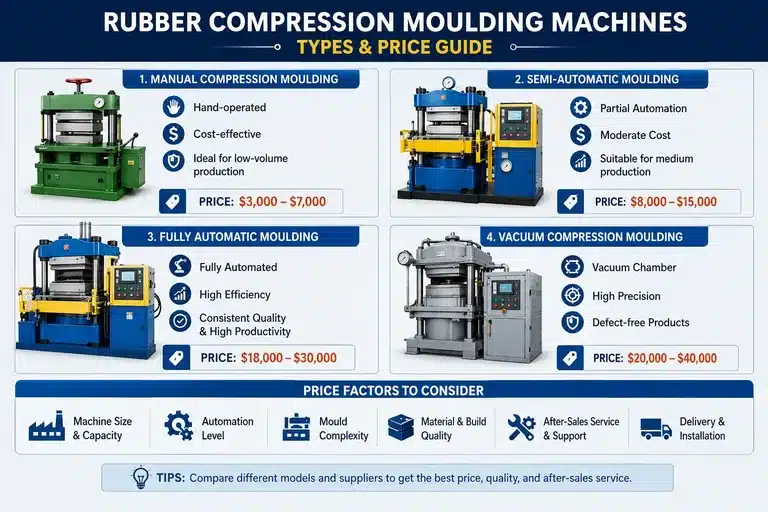
Rubber Compression Molding Process Optimization Guide 2026
Rubber Compression Molding Process Optimization Guide 2026
Rubber compression molding remains a cost-effective method for producing seals, gaskets, O-rings, and vibration isolation components. In 2026, manufacturers in the United States, United Kingdom, Germany, Netherlands, Italy, and France are optimizing compression molding processes to improve cycle times, reduce scrap, and meet stricter quality requirements from automotive, aerospace, and medical customers.
This guide explains the key variables that govern compression molding performance. It covers process parameters, mold design, material handling, automation, and quality control with practical recommendations for shop-floor implementation.
Table of Contents
- Why Compression Molding Optimization Matters
- Process Parameters and Control
- Mold Design Best Practices
- Material Selection and Preparation
- Cycle Time Reduction Techniques
- Quality Defects and Root Causes
- Automation and Process Monitoring
- Energy Efficiency in Curing
- Maintenance and Tooling Life
- Cost and ROI Considerations
- Regional Implementation Trends
- Frequently Asked Questions
Why Compression Molding Optimization Matters
Compression molding is often chosen for its low tooling cost and flexibility. However, the process is sensitive to temperature, pressure, and material consistency. Small variations can cause flash, porosity, dimensional inconsistency, and premature failure in the field. Optimized processes deliver higher first-pass yield, lower rework, and more predictable delivery schedules.
In 2026, sustainability pressures add another layer. Reducing scrap, minimizing energy consumption, and extending mold life directly lower the carbon footprint per part.
Process Parameters and Control
Temperature Profile
Mold temperature determines cure rate and crosslink density. Typical molding temperatures range from 150°C to 200°C depending on compound chemistry. Uniform platten temperature is essential for consistent curing.
Pressure and Press Closing Speed
Adequate pressure forces material into the cavity and suppresses void formation. Excessive pressure causes flash and accelerates mold wear. Press closing speed affects air evacuation and knit line formation.
Cure Time
Cure time must be sufficient to achieve full crosslinking without degrading the compound. Undercure reduces mechanical properties while overcure can cause brittleness and discoloration.
Mold Design Best Practices
Cavity Layout and Flow Balance
Balanced cavity filling ensures consistent part dimensions across multi-cavity tools. Simulation software helps predict material flow and identify stagnant zones.
Venting and Flash Control
Proper venting allows trapped air to escape during mold closure. Flash grooves and tight shutoff surfaces control excess material while protecting parting lines.
Heating Channel Design
Steam, oil, or electric cartridge channels must provide uniform temperature distribution. Cold spots extend cure time and cause inconsistent properties.
Material Selection and Preparation
Compound selection balances hardness, tensile strength, elongation, compression set, and environmental resistance. Preforming blanks to consistent weight and shape reduces variation. Material should be conditioned to stable temperature and humidity before molding. German and US suppliers offer pre-compounded materials with detailed cure rheology data.
Cycle Time Reduction Techniques
- Optimize mold temperature to minimize cure time without sacrificing quality.
- Use fast-heating platens and insulated molds to reduce thermal losses.
- Implement automated loading and unloading to reduce operator variability.
- Apply mold release coatings that minimize sticking and cleaning time.
- Reduce non-productive time through preventive maintenance scheduling.
Quality Defects and Root Causes
| Defect | Likely Cause | Corrective Action |
|---|---|---|
| Flash | Excessive pressure or worn parting line | Reduce pressure, repair shutoffs |
| Porosity | Trapped air or moisture | Improve venting, dry compound |
| Undercure | Low temperature or short cure time | Increase temperature or time |
| Dimensional variation | Inconsistent blank weight or temperature | Standardize preforms, monitor platens |
Automation and Process Monitoring
Modern compression presses feature closed-loop temperature control, pressure profiling, and cycle data logging. Vision systems inspect parts for flash, voids, and dimensional defects. Robotic part removal reduces cycle time and improves consistency. Italian and French automotive suppliers are increasingly adopting automated compression cells for high-volume seals.
Energy Efficiency in Curing
Electric presses with insulated platens consume less energy than older steam or hydraulic systems. Idle mode features reduce power draw between cycles. Scheduling production to maintain press temperature rather than frequent cold starts saves significant energy over a year.
Maintenance and Tooling Life
Regular mold cleaning, parting line inspection, and plating renewal extend tooling life. Press maintenance includes hydraulic fluid analysis, heater resistance checks, and alignment verification. A well-maintained compression mold can produce hundreds of thousands to millions of parts depending on geometry and material abrasiveness.
Cost and ROI Considerations
Optimization investments include process monitoring systems, mold refurbishment, automation retrofits, and operator training. Typical payback periods range from six months to two years through scrap reduction, labor savings, and increased throughput. Dutch and UK manufacturers often quantify carbon savings as an additional ROI component.
Regional Implementation Trends
German manufacturers lead in process monitoring and statistical process control for rubber molding. US companies focus on automation and high-volume throughput. Italian specialists excel in precision seals and fashion-related rubber goods. French and UK firms emphasize sustainable compounds and energy-efficient equipment.
Frequently Asked Questions
What materials work best in compression molding?
Common materials include silicone, nitrile, EPDM, fluorocarbon, and natural rubber. Selection depends on temperature, chemical exposure, and mechanical requirements.
How can I reduce flash in compression molding?
Reduce molding pressure, ensure balanced cavity fill, maintain clean parting lines, and inspect molds for wear.
What is a typical compression molding cycle time?
Cycle times range from one minute for thin parts to ten minutes or more for thick sections, depending on compound and cure requirements.
Is compression molding cheaper than injection molding?
For low volumes and simple geometries, compression molding has lower tooling costs. For high volumes and complex shapes, injection molding is usually more economical.
How do I monitor cure state?
Cure state can be monitored through press temperature, cure time, and rheometer data. Advanced systems use dielectric sensors for real-time cure monitoring.
Conclusion
Optimizing rubber compression molding requires attention to temperature, pressure, material, mold design, and process control. In 2026, manufacturers that combine traditional molding expertise with modern monitoring and automation will achieve higher yields, lower costs, and stronger customer relationships. Continuous improvement should be driven by data, operator involvement, and regular process reviews.

