Additive vs Conventional Manufacturing Cost Analysis for 2026
Additive vs Conventional Manufacturing Cost Analysis for 2026
Manufacturers evaluating production technologies in 2026 must look beyond headline equipment prices. The true economics of laser sintering compared with conventional methods depend on part geometry, production volume, material utilization, post-processing requirements, and supply chain flexibility. Companies in the United States, United Kingdom, Germany, Netherlands, Italy, and France are using detailed cost models to decide where each technology fits.
This analysis provides a practical framework for comparing laser sintering with machining, casting, and molding. It identifies the cost drivers that matter most and explains when additive production delivers genuine financial advantage.
Table of Contents
- Understanding the Cost Comparison Framework
- Capital Equipment and Setup Costs
- Material Costs and Utilization
- Labor and Post-Processing
- Tooling and Changeover Economics
- Breakeven Volume Analysis
- Applications Favoring Laser Sintering
- Applications Favoring Conventional Methods
- Hidden Costs and Risk Factors
- Regional Cost Benchmarks
- Decision Matrix
- Frequently Asked Questions
Understanding the Cost Comparison Framework
Cost comparisons fail when they focus only on machine rates or material prices. A complete model includes capital depreciation, facility overhead, labor, consumables, quality inspection, rework, inventory carrying costs, and the opportunity cost of longer lead times. Laser sintering and conventional manufacturing each create value in different parts of this equation.
Capital Equipment and Setup Costs
Laser Sintering Systems
Industrial polymer laser sintering systems range from \$200,000 to over \$1 million depending on build volume, laser power, and throughput. Metal laser sintering systems typically start around \$500,000 and can exceed \$2 million for multi-laser platforms.
Conventional Machine Tools
CNC machining centers range from \$100,000 to \$750,000. Injection molding machines vary from \$50,000 for small units to several million dollars for large-tonnage presses. Casting requires pattern, mold, and core-making equipment.
Setup and Programming
Additive part setup involves nesting, support generation, and parameter selection. Conventional setup includes fixture design, CAM programming, and first-article inspection. For complex geometries, additive setup can be faster and less expensive.
Material Costs and Utilization
Laser sintering powders cost significantly more per kilogram than conventional raw materials. Polyamide 12 powder for selective laser sintering can cost \$50 to \$120 per kilogram, while metal powders for laser powder bed fusion range from \$80 to \$600 per kilogram depending on alloy.
However, additive manufacturing uses material only where needed. Buy-to-fly ratios near 1:1 reduce waste for complex parts. Conventional machining can waste 70% to 90% of material for aerospace components. Molding and casting minimize material waste but require runners, risers, and flash removal.
Labor and Post-Processing
Laser sintered parts require depowdering, support removal, heat treatment, surface finishing, and inspection. Metal parts often need stress relief, hot isostatic pressing, and CNC finishing of critical surfaces. These steps can represent 30% to 70% of total part cost.
Conventional manufacturing also requires post-processing, including deburring, surface treatment, and inspection. The labor intensity depends on part complexity and tolerances rather than the technology itself.
Tooling and Changeover Economics
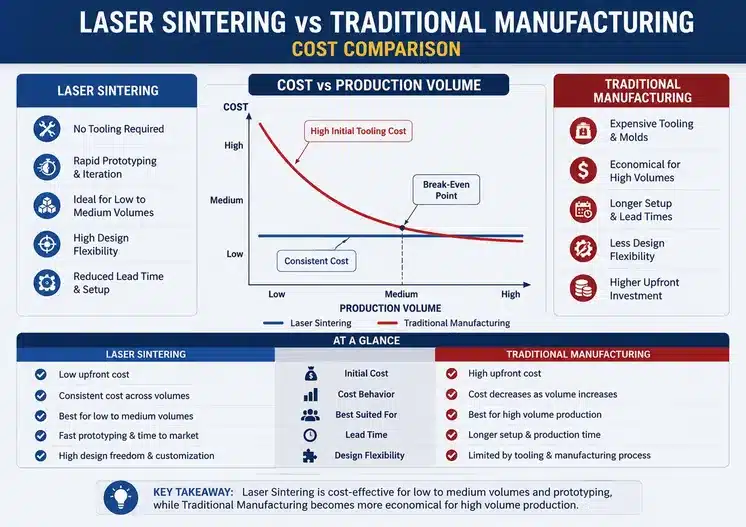
Tooling is often the decisive factor. Injection molds cost \$5,000 to \$250,000 and take weeks to months to produce. Casting patterns and dies require similar investments. Laser sintering requires no tooling, making it economically attractive for low volumes and design iterations.
Breakeven Volume Analysis
| Technology | Tooling Cost | Unit Cost Trend | Best Volume Range |
|---|---|---|---|
| Laser sintering | None | Flat per part | 1 to 1,000 units |
| CNC machining | Fixtures only | Moderate decrease | 10 to 10,000 units |
| Injection molding | High | Steep decrease | 10,000+ units |
| Die casting | High | Steep decrease | 5,000+ units |
Applications Favoring Laser Sintering
Laser sintering excels where complexity adds value rather than cost. Consolidating multi-part assemblies into single components, creating conformal cooling channels, producing lightweight lattice structures, and manufacturing patient-specific medical devices are proven applications. Aerospace, medical, and motorsport sectors in Germany, the UK, and Italy lead adoption.
Applications Favoring Conventional Methods
Conventional methods remain dominant for high-volume production of simple geometries, tight-tolerance features requiring ground surfaces, and large structural parts. Automotive production, consumer goods, and standard hardware rely on molding, casting, and machining for cost efficiency.
Hidden Costs and Risk Factors
Qualification and Certification
Regulated industries require extensive material and process qualification. Building an approved additive process can cost tens of thousands of dollars and take months.
Design Expertise
Additive manufacturing requires design for additive manufacturing skills. Without proper training, engineers may create parts that are printable but not economical.
Supply Chain and Powder Management
Powder handling, recycling protocols, and traceability add operational complexity. Moisture-sensitive powders require controlled storage conditions.
Regional Cost Benchmarks
German manufacturers benefit from a dense ecosystem of additive machine builders and service bureaus. UK aerospace companies leverage government funding for additive qualification. US firms focus on production-scale metal additive systems. French and Italian manufacturers use additive for fashion, automotive, and dental applications. Dutch companies emphasize supply chain resilience through distributed additive production.
Decision Matrix
- Choose laser sintering for low volumes, complex geometries, rapid iteration, and customization.
- Choose machining for precision features, medium volumes, and tough engineering materials.
- Choose injection molding for high volumes of plastic parts with simple to moderate complexity.
- Choose casting for large metal parts and high volumes where tooling investment is justified.
Frequently Asked Questions
Is laser sintering cheaper than CNC machining?
For one-off complex parts, laser sintering is often cheaper due to no tooling. For medium volumes of simple parts, machining is usually more economical.
What is the breakeven volume between additive and molding?
Breakeven depends on part size and complexity, but typically falls between 500 and 5,000 units for polymer parts.
Why are metal powders so expensive?
Metal powders require atomization under controlled atmospheres, stringent size distribution control, and qualification testing. Supply chain scale is smaller than conventional bar stock.
Does laser sintering eliminate post-processing?
No. Most laser sintered parts require post-processing for surface finish, dimensional accuracy, and mechanical properties.
Which industries benefit most from laser sintering?
Aerospace, medical devices, motorsports, tooling, and high-performance industrial equipment benefit most.
Conclusion
Laser sintering and conventional manufacturing are complementary rather than competing technologies. The right choice depends on volume, complexity, tolerance, material, and lead-time requirements. In 2026, manufacturers that build robust cost models and match each technology to its strengths will capture the full value of both additive and conventional production.
Comments (3)