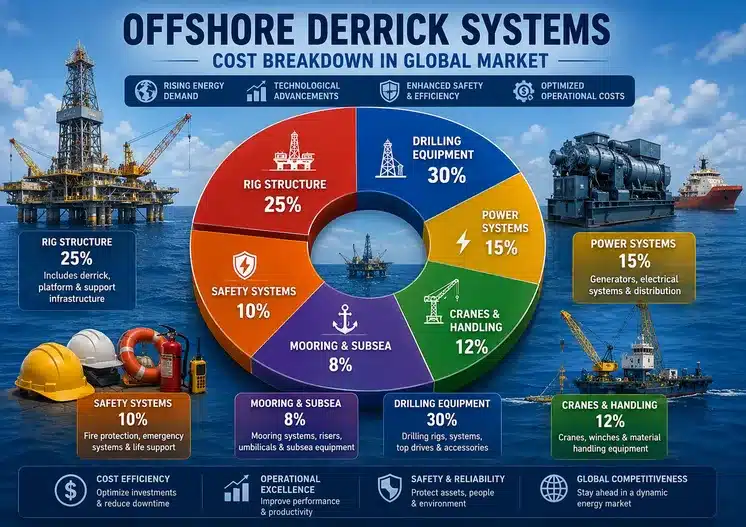
Offshore Derrick System Cost Modeling and Project Economics 2026
Offshore Derrick System Cost Modeling and Project Economics 2026
Offshore derrick systems remain central to drilling, workover, and platform construction operations. As exploration moves into deeper waters and harsher environments, the economics of derrick selection have become more complex. Operators in the North Sea, Gulf of Mexico, offshore Brazil, and West Africa need accurate cost models that account for capital expenditure, installation, operations, maintenance, and regulatory compliance.
This guide presents a comprehensive framework for offshore derrick system cost modeling in 2026. It breaks down the major cost categories and explains how project economics should be evaluated over the full asset lifecycle.
Table of Contents
- Why Offshore Derrick Economics Matter in 2026
- Derrick System Components and Functions
- Capital Expenditure Categories
- Installation and Commissioning Costs
- Operating Expenditure Drivers
- Maintenance and Inspection Regimes
- Regulatory and Insurance Costs
- Cost Modeling Approaches
- Regional Market Variations
- Risk Factors and Contingencies
- Total Cost of Ownership Case Study
- Frequently Asked Questions
Why Offshore Derrick Economics Matter in 2026
Offshore projects involve billions of dollars in capital and decades of operational commitment. Derrick systems represent a material share of platform construction costs and a recurring source of operating expense. Poor selection or underestimation of lifecycle costs can erode project returns and create safety risks.
In 2026, operators are under pressure to reduce breakeven costs, extend field life, and meet stringent emissions and safety standards. Accurate cost modeling supports better tender evaluations, contract negotiations, and maintenance planning.
Derrick System Components and Functions
Mast and Derrick Structure
The structural tower supports hoisting equipment and drilling loads. Design must withstand dynamic loads from wind, waves, vessel motion, and drilling operations.
Hoisting and Drawworks
The hoisting system includes the crown block, traveling block, hook, and drawworks. Capacity ratings determine the maximum drill string weight that can be handled.
Pipe Handling Systems
Automated pipe handling reduces manual intervention and improves safety. These systems add capital cost but reduce cycle time and personnel exposure.
Control and Safety Systems
Modern derricks incorporate programmable logic controllers, anti-collision systems, load monitoring, and emergency shutdown functions.
Capital Expenditure Categories
| Category | Typical Cost Range | Notes |
|---|---|---|
| Derrick structure and materials | \$3M to \$15M | Depends on height, load rating, and material grade |
| Hoisting equipment | \$5M to \$25M | Higher capacities and dual systems increase cost |
| Pipe handling automation | \$2M to \$8M | Reduces crew size and improves safety |
| Controls and instrumentation | \$1M to \$5M | Increasingly digital and integrated |
| Engineering and project management | 10% to 20% of hardware | Includes classification and certification |
Installation and Commissioning Costs
Transportation, heavy-lift installation, hookup, and commissioning add significant cost. Offshore installation requires specialized vessels, weather windows, and integration with platform utilities. Commissioning includes load testing, safety system verification, and crew training.
Operating Expenditure Drivers
Operating costs include crew salaries, power consumption, lubricants, spare parts, inspections, and logistics. Automated systems reduce crew requirements but increase dependence on specialized technicians and electronic spare parts. Fuel and power costs are rising considerations as offshore electrification and emissions targets gain importance.
Maintenance and Inspection Regimes
Offshore derricks require preventive maintenance based on running hours, load cycles, and calendar intervals. Inspections cover structural welds, wire ropes, sheaves, brakes, and safety devices. Predictive maintenance using sensors and drone inspections is becoming common for hard-to-access areas.
Regulatory and Insurance Costs
Classification societies such as DNV, ABS, and Lloyd's Register set construction and inspection standards. National regulators impose additional requirements for well control, lifting operations, and environmental protection. Insurance premiums reflect safety records, asset condition, and operational location.
Cost Modeling Approaches
Bottom-Up Estimating
Detailed estimates based on equipment lists, vendor quotations, and activity schedules. This approach is most accurate but time-consuming.
Parametric Estimating
Cost models based on historical data and key parameters such as water depth, load capacity, and automation level. Useful in early project stages.
Lifecycle Cost Analysis
Discounted cash flow analysis over the field life, incorporating capital, operating, maintenance, and decommissioning costs.
Regional Market Variations
North Sea operations face high labor and regulatory costs but benefit from mature supply chains. Gulf of Mexico projects emphasize hurricane resilience and rapid mobilization. Offshore West Africa and Brazil focus on deepwater capability and local content requirements. Middle East projects prioritize high-temperature durability and cost efficiency.
Risk Factors and Contingencies
Major risks include schedule delays from weather or logistics, cost overruns from scope changes, equipment failures causing downtime, and regulatory changes affecting inspection frequencies. Contingency allowances of 15% to 25% are common for offshore projects.
Total Cost of Ownership Case Study
Consider a modular drilling rig with a twenty-year field life. Initial derrick system capital might total \$40 million. Installation and commissioning add \$10 million. Annual operating and maintenance costs average \$4 million. Over twenty years, the derrick system represents \$130 million in lifecycle spending, making operating decisions as important as the initial purchase.
Frequently Asked Questions
What is the largest cost driver for offshore derrick systems?
Over a full project lifecycle, operating and maintenance costs typically exceed capital costs, especially for long-duration fields.
How does automation affect derrick economics?
Automation increases upfront capital but reduces crew size, improves safety, and can shorten drilling cycles.
What inspections are required for offshore derricks?
Inspections include structural surveys, non-destructive testing, load testing, wire rope examination, and safety system validation.
How long does an offshore derrick last?
With proper maintenance, a derrick structure can last thirty years or more, though hoisting components and controls are replaced multiple times.
What contingency should be included in derrick cost estimates?
Most offshore projects include contingencies of 15% to 25% to address weather, logistics, and scope uncertainty.
Conclusion
Offshore derrick system cost modeling requires a lifecycle perspective that integrates capital, installation, operation, maintenance, and regulatory costs. In 2026, operators that use detailed parametric and bottom-up models, account for regional variations, and incorporate risk contingencies will make better investment decisions and manage assets more profitably over time.
Comments (3)