Hydropower Generation Economics for Industrial Facilities in 2026
Hydropower Generation Economics for Industrial Facilities in 2026
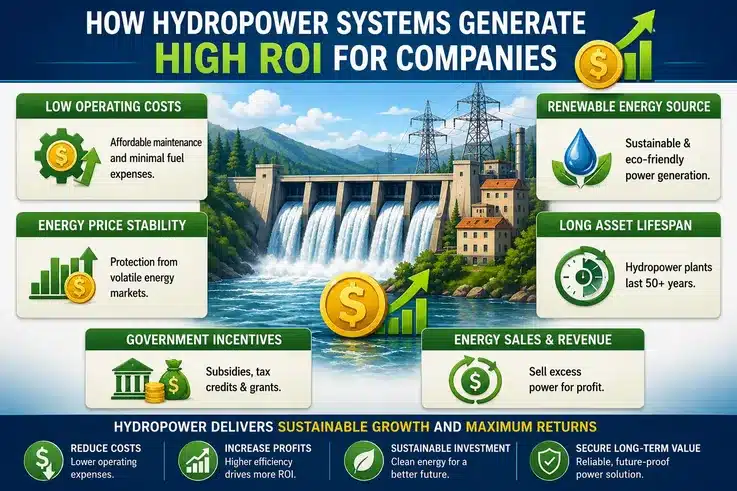
Industrial energy costs remain volatile, pushing manufacturers toward self-generation options with predictable economics. Hydropower offers some of the lowest levelized costs among renewable sources, making it attractive for facilities located near suitable water resources.
This guide examines the economics of hydropower generation for industrial users across the USA, UK, Germany, Netherlands, Italy, and France. It covers capacity factors, revenue models, development costs, and financing structures.
Table of Contents
- Hydropower Economics Overview
- Capacity Factors and Energy Yield
- Development and Operating Costs
- Revenue Models for Industrial Hydropower
- Financing Structures
- Regional Market Conditions
- Risk Factors and Mitigation
- Frequently Asked Questions
Hydropower Economics Overview
Hydropower economics depend on water availability, head, installed capacity, and local electricity prices. Run-of-river systems typically have lower environmental impact and shorter permitting timelines than large reservoir projects.
Key Economic Metrics
- Levelized cost of energy (LCOE)
- Net present value (NPV)
- Internal rate of return (IRR)
- Payback period
- Capacity factor
Capacity Factors and Energy Yield
Capacity factors for run-of-river hydropower typically range from 40% to 70%, depending on flow reliability. Storage hydropower can achieve higher capacity factors by managing water release.
| System Type | Capacity Factor | Typical Size |
|---|---|---|
| Run-of-river | 40% - 70% | 100 kW to 10 MW |
| Small reservoir | 50% - 80% | 1 MW to 50 MW |
| Micro hydro | 30% - 60% | 5 kW to 100 kW |
Development and Operating Costs
Capital Expenditure
Small hydropower projects can cost between \$2,000 and \$6,000 per installed kilowatt. Costs include civil works, turbine equipment, generators, electrical infrastructure, and permitting.
Operating Expenditure
Operating costs are relatively low, typically 1% to 3% of capital cost annually. Maintenance focuses on turbine overhaul, generator servicing, and intake cleaning.
Revenue Models for Industrial Hydropower
Self-Consumption
Industrial facilities use generated power on-site, reducing grid purchases. This model provides the simplest economics and avoids transmission losses.
Grid Export
Excess power can be sold to the grid under feed-in tariffs or power purchase agreements. German and UK industrial sites have historically benefited from stable feed-in mechanisms.
Behind-the-Meter with Battery Storage
Adding battery storage allows facilities to shift hydropower output to peak price periods, improving project economics in markets with time-of-use pricing.
Financing Structures
Hydropower projects can be financed through corporate balance sheets, project finance, green bonds, or equipment leasing. Development banks and green funds increasingly support small hydropower in Europe and North America.
Regional Market Conditions
Germany and France offer mature regulatory frameworks for small hydropower. The UK and Italy have active incentive programs, while the USA provides federal tax credits and state-level renewable energy credits. The Netherlands has limited hydro potential but supports innovative low-head solutions.
Risk Factors and Mitigation
Hydrological Risk
Variable rainfall and seasonal flow affect generation. Long-term flow records and conservative yield estimates reduce this risk.
Regulatory Risk
Water rights and environmental permits can be complex. Early engagement with regulators and environmental assessments smooth the approval process.
Frequently Asked Questions
What is the typical payback for industrial hydropower?
Payback periods typically range from 6 to 15 years, depending on site conditions, electricity prices, and available incentives.
How much does a small hydropower plant cost?
Capital costs range from approximately \$2,000 to \$6,000 per installed kilowatt for small run-of-river systems.
Can hydropower work for off-grid industrial sites?
Yes. Hydropower is well-suited for off-grid sites with reliable water flow, often providing more stable output than solar or wind.
What incentives are available?
Incentives include feed-in tariffs, renewable energy credits, tax credits, green bonds, and low-interest development loans.
Is hydropower generation predictable?
Hydropower is among the most predictable renewable sources when based on historical flow data and proper hydrological studies.
What maintenance does hydropower require?
Maintenance includes turbine inspection, generator servicing, bearing replacement, and intake cleaning. Annual O&M costs are typically 1% to 3% of capital cost.
How does hydropower compare to solar for industrial use?
Hydropower offers higher capacity factors and predictable output but requires suitable water resources. Solar has lower capital cost but more variable generation.
Conclusion
Hydropower generation economics remain compelling for industrial facilities with access to suitable water resources. By understanding capacity factors, costs, revenue models, and risks, manufacturers can make informed investment decisions.
Facilities across the USA, UK, Germany, Netherlands, Italy, and France that evaluate hydropower in 2026 can secure long-term energy price stability and reduce their carbon footprint.
Comments (3)