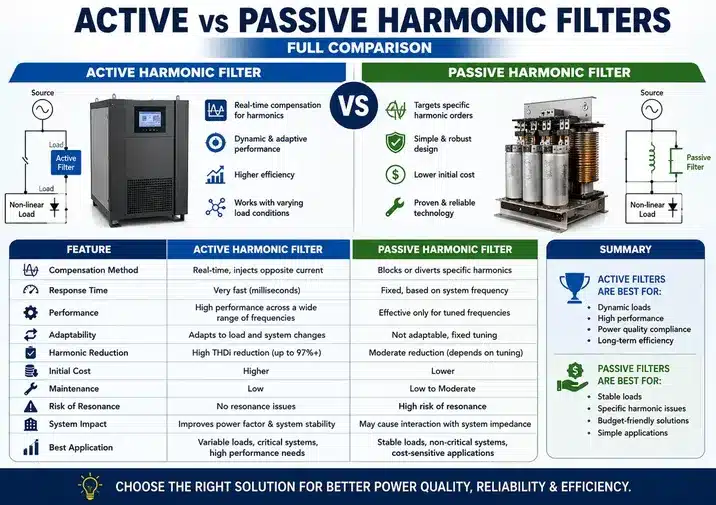
Active vs Passive Harmonic Filters: Selection Guide for Industrial Plants 2026
Active vs Passive Harmonic Filters: Selection Guide for Industrial Plants 2026
Power quality has become a strategic concern for industrial plants as variable frequency drives, rectifiers, and switching power supplies proliferate. Harmonic distortion causes equipment overheating, transformer losses, nuisance tripping, and higher energy bills. In 2026, facilities across the United States, United Kingdom, Germany, Netherlands, Italy, and France are evaluating active and passive harmonic filters to protect equipment and comply with grid codes.
This selection guide explains the differences between active and passive harmonic filters. It covers operating principles, applications, costs, and decision criteria for industrial plants.
Table of Contents
- Understanding Power Harmonics
- Passive Filter Design and Applications
- Active Filter Technology
- Hybrid Filter Solutions
- Selection Criteria
- Cost Comparison
- Installation and Commissioning
- Maintenance and Reliability
- Compliance and Standards
- Frequently Asked Questions
Understanding Power Harmonics
Harmonics are integer multiples of the fundamental frequency that distort voltage and current waveforms. Non-linear loads such as variable frequency drives, UPS systems, and LED drivers draw current in pulses, generating harmonic currents. These currents flow through the plant electrical system and can cause resonance, overheating, and equipment malfunction.
Passive Filter Design and Applications
Tuned Passive Filters
Tuned filters use inductors and capacitors resonant at a specific harmonic frequency. They are cost-effective for plants with stable, well-defined harmonic profiles such as six-pulse drives.
Detuned Capacitor Banks
Detuned banks provide power factor correction while avoiding resonance with background harmonics. They are often the first step in power quality improvement.
Limitations of Passive Filters
Passive filters are sensitive to system impedance, load changes, and temperature. They can create resonance with the grid and may not address multiple harmonic orders effectively.
Active Filter Technology
Active harmonic filters inject compensating currents that cancel harmonic distortion. They adapt automatically to changing loads and can address multiple harmonic orders simultaneously. Active filters are ideal for plants with mixed loads, frequent changes, and strict power quality requirements.
Hybrid Filter Solutions
Hybrid systems combine passive filters for dominant harmonics with active filters for dynamic correction. They offer a balance of cost and performance for large plants with complex distortion profiles.
Selection Criteria
| Factor | Passive Filter | Active Filter |
|---|---|---|
| Load stability | Best for stable loads | Best for variable loads |
| Harmonic spectrum | Tuned to specific orders | Broadband correction |
| Power factor | Can provide correction | Some models provide correction |
| Footprint | Larger for high power | Compact modular design |
| Initial cost | Lower | Higher |
Cost Comparison
Passive filters generally have lower upfront costs but may require engineering studies and careful tuning. Active filters have higher capital costs but reduce engineering risk and adapt to future load changes. Lifecycle cost analysis should include energy savings, maintenance, and avoided downtime.
Installation and Commissioning
Passive filters must be installed at the right location to avoid resonance and provide effective attenuation. Active filters require current transformers and communication cabling for proper operation. Commissioning includes harmonic measurements before and after installation to verify performance.
Maintenance and Reliability
Passive filter components such as capacitors and reactors require periodic inspection. Active filters have fewer moving parts but depend on power electronics and cooling systems. Both technologies benefit from thermal monitoring and protective relaying.
Compliance and Standards
Power quality standards such as IEEE 519, EN 50160, and local utility codes define harmonic limits. Compliance avoids penalties and ensures connection agreements remain valid. German and Dutch utilities are particularly strict about harmonic emissions.
Future Trends and Regional Considerations
Wide Bandgap Power Electronics
Modern active vs passive harmonic filters increasingly depends on Wide Bandgap Power Electronics. The technology and practices involved are maturing rapidly, making adoption more accessible across facility sizes.
Facilities in France, Germany, and the Netherlands demonstrate that Wide Bandgap Power Electronics can deliver practical value in active vs passive harmonic filters without requiring massive capital outlays. Scalable deployment models are helping smaller players participate.
Grid-Interactive Industrial Plants
Grid-Interactive Industrial Plants represents a significant evolution in active vs passive harmonic filters. Organizations that master this area can differentiate their offerings and build more resilient operations.
In Italy, France, and the United Kingdom, engineering teams are using Grid-Interactive Industrial Plants to solve long-standing challenges in active vs passive harmonic filters. The approach is gaining traction among both large enterprises and specialized suppliers.
Cybersecurity in Power Quality Systems
Cybersecurity in Power Quality Systems is reshaping how organizations approach active vs passive harmonic filters. It addresses critical performance gaps while creating opportunities for efficiency, compliance, and competitive differentiation.
Companies in Germany, France, and the United States report meaningful gains after embedding Cybersecurity in Power Quality Systems into active vs passive harmonic filters workflows. These improvements span productivity, quality, and environmental performance.
Frequently Asked Questions
When should I choose an active filter?
Choose an active filter when loads are variable, harmonics span multiple orders, or power quality requirements are stringent.
Can passive and active filters be used together?
Yes. Hybrid solutions use passive filters for dominant harmonics and active filters for dynamic and residual correction.
What is the typical payback for harmonic filters?
Payback ranges from one to four years depending on energy savings, avoided penalties, and reduced equipment maintenance.
Do harmonic filters save energy?
They reduce losses in transformers, cables, and motors caused by harmonic currents. Savings are most significant in plants with high distortion.
How do I measure harmonic levels?
Power quality analyzers measure total harmonic distortion and individual harmonic orders. Baseline measurements are essential before filter selection.
Conclusion
Choosing between active and passive harmonic filters requires a clear understanding of the plant's load profile, harmonic spectrum, and power quality goals. In 2026, industrial plants that conduct proper measurements and select the right technology will protect equipment, reduce energy costs, and maintain compliance with evolving grid codes.
Comments (3)