Industrial Energy Loss Reduction Through Power Quality and Automation 2026
Industrial Energy Loss Reduction Through Power Quality and Automation 2026
Industrial facilities waste significant energy through poor power quality, inefficient motors, and unoptimized processes. In 2026, manufacturers across the USA, UK, Germany, Netherlands, Italy, and France are combining power quality correction with automation to cut energy losses and operating costs.
This guide explores the causes of industrial energy loss and presents practical strategies including harmonic filtering, power factor correction, variable frequency drives, and intelligent monitoring.
Table of Contents
- Sources of Industrial Energy Loss
- Harmonic Distortion and Energy Waste
- Power Factor Correction
- Variable Frequency Drive Optimization
- Energy Monitoring and Analytics
- Automation for Energy Efficiency
- ROI and Implementation Priorities
- Frequently Asked Questions
Sources of Industrial Energy Loss
Energy losses occur throughout industrial facilities. Common sources include motor inefficiency, transformer losses, heat loss in furnaces, compressed air leaks, and poor power quality.
Major Loss Categories
- Motor and drive losses
- Transformer and cable losses
- Harmonic losses
- Power factor penalties
- Process inefficiencies
- Compressed air and steam leaks
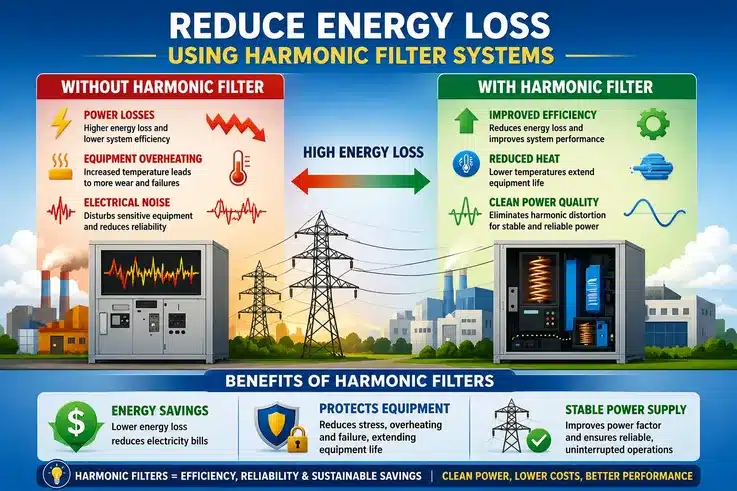
Harmonic Distortion and Energy Waste
Non-linear loads such as variable frequency drives, rectifiers, and LED power supplies generate harmonic currents. These harmonics increase heating in transformers, cables, and motors, wasting energy and shortening equipment life.
Harmonic Mitigation Strategies
- Passive harmonic filters
- Active harmonic filters
- Twelve-pulse or eighteen-pulse drives
- Active front-end drives
- Line reactors
Power Factor Correction
Low power factor increases reactive power demand and can trigger utility penalties. Capacitor banks and automatic power factor correction systems reduce reactive power and improve voltage stability.
| Power Factor | Typical Penalty | Action |
|---|---|---|
| Above 0.95 | None | Maintain |
| 0.85 to 0.95 | Possible | Correct |
| Below 0.85 | Likely | Correct urgently |
Variable Frequency Drive Optimization
VFDs save energy by matching motor speed to load requirements. However, improper settings, oversized motors, and bypassed drives can eliminate savings. Regular audits ensure VFDs operate efficiently.
Energy Monitoring and Analytics
Modern energy management systems provide real-time visibility into consumption patterns. Sub-metering identifies the biggest opportunities for savings and verifies the impact of improvement projects.
Automation for Energy Efficiency
Building management systems and process automation reduce energy waste by optimizing equipment scheduling, setpoints, and sequencing. German and Dutch manufacturers lead in integrating energy management with production automation.
ROI and Implementation Priorities
Quick wins include fixing compressed air leaks, optimizing VFDs, and correcting power factor. Larger investments such as active harmonic filters and energy management systems typically pay back within two to four years.
| Measure | Typical Savings | Payback |
|---|---|---|
| Power factor correction | 2% - 10% | 1 - 3 years |
| Harmonic filtering | 3% - 8% | 2 - 5 years |
| VFD optimization | 10% - 30% on fan/pump loads | 1 - 3 years |
| Energy monitoring | 5% - 15% | 1 - 4 years |
Future Trends and Regional Considerations
Power Factor Correction Upgrades
Power Factor Correction Upgrades represents a significant evolution in guide to reduce energy. Organizations that master this area can differentiate their offerings and build more resilient operations.
Organizations in Italy, France, and the United Kingdom are integrating Power Factor Correction Upgrades into their operations to reduce risk, lower costs, and improve outcomes. In 2026, this trend is accelerating as digital tools, tighter regulations, and customer expectations drive investment.
Compressed Air Optimization
As manufacturers pursue guide to reduce energy, Compressed Air Optimization has emerged as a key enabler. It helps teams overcome traditional constraints and respond faster to changing market demands.
Companies in Italy, the United States, and the United Kingdom report meaningful gains after embedding Compressed Air Optimization into guide to reduce energy workflows. These improvements span productivity, quality, and environmental performance.
Smart Building Integration
The adoption of Smart Building Integration within guide to reduce energy is accelerating as companies seek measurable improvements. This shift reflects broader industry pressures around cost, quality, and sustainability.
Organizations in Italy, the United States, and the United Kingdom are integrating Smart Building Integration into their operations to reduce risk, lower costs, and improve outcomes. In 2026, this trend is accelerating as digital tools, tighter regulations, and customer expectations drive investment.
Frequently Asked Questions
What causes harmonic distortion?
Non-linear loads such as VFDs, rectifiers, switching power supplies, and arc furnaces draw current in pulses, creating harmonic frequencies.
How do active harmonic filters work?
Active filters inject counter-phase harmonic currents to cancel distortion. They adapt automatically to changing load conditions.
What is power factor?
Power factor is the ratio of real power to apparent power. Low power factor indicates inefficient use of electrical capacity.
Can energy monitoring reduce bills?
Yes. Monitoring identifies waste, optimizes demand, and verifies savings from efficiency projects.
Which loads should get VFDs first?
Fans, pumps, and compressors with variable demand offer the fastest VFD savings.
Are utility penalties common?
Many utilities charge penalties for low power factor or high demand. Power quality improvements can eliminate these charges.
How much can automation save?
Automation projects typically reduce energy use by 5% to 20%, depending on baseline efficiency and integration scope.
Conclusion
Industrial energy loss reduction combines power quality correction, drive optimization, monitoring, and automation. Manufacturers that take a systematic approach can cut costs while improving equipment reliability.
Facilities across the USA, UK, Germany, Netherlands, Italy, and France that invest in these measures in 2026 will reduce both energy expenses and carbon emissions.
Comments (3)