Submerged Arc Welding Efficiency Optimization for Heavy Fabrication 2026
Submerged Arc Welding Efficiency Optimization for Heavy Fabrication 2026
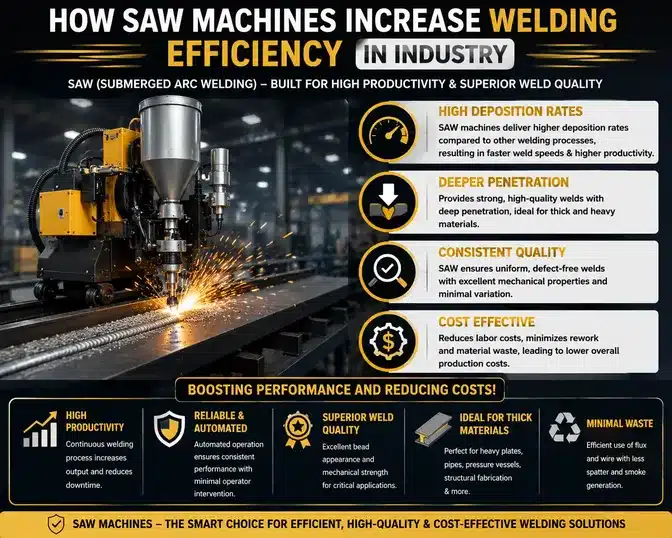
Submerged arc welding is the workhorse of heavy fabrication, delivering deep penetration, high deposition rates, and excellent mechanical properties. In 2026, fabricators across the United States, United Kingdom, Germany, Netherlands, Italy, and France are optimizing SAW processes to reduce costs, improve quality, and meet aggressive delivery schedules. Efficiency gains come from better parameter control, consumables management, automation, and joint design.
This guide explores practical strategies for improving submerged arc welding efficiency in heavy fabrication environments. It covers equipment settings, consumables, automation, and quality control.
Table of Contents
- Fundamentals of SAW Efficiency
- Wire and Flux Selection
- Travel Speed and Heat Input
- Joint Design and Fit-Up
- Automation and Positioning
- Flux Handling and Recovery
- Power Source Settings
- Quality and Rework Reduction
- Maintenance and Consumables
- Frequently Asked Questions
Fundamentals of SAW Efficiency
SAW efficiency is measured by deposition rate, travel speed, arc time, and rework rate. Unlike manual welding, SAW operates under a blanket of granular flux that protects the molten pool and suppresses spatter. This allows high currents and fast travel speeds without sacrificing weld quality.
Wire and Flux Selection
Wire Composition and Diameter
Wire selection must match base metal chemistry and service requirements. Larger diameters enable higher deposition rates but require higher currents.
Flux Types
Fluxes are classified as fused, bonded, or agglomerated. Each type offers different handling characteristics, moisture resistance, and metallurgical behavior. Proper storage and recycling are essential to prevent porosity.
Recycled Flux Ratio
Recycling recovered flux reduces material cost. However, excessive recycling can alter flux chemistry and introduce contamination. A controlled blend of virgin and recovered flux maintains consistency.
Travel Speed and Heat Input
Heat input affects weld metal properties and distortion. Higher travel speeds increase productivity but may reduce penetration if parameters are not balanced. Procedure qualification records define acceptable heat input ranges for each application.
Joint Design and Fit-Up
Proper joint preparation reduces the amount of weld metal required and minimizes defects. Tight fit-up, correct root openings, and proper bevel angles improve efficiency. Poor fit-up causes excessive buildup, distortion, and rework.
Automation and Positioning
Column and boom manipulators, welding tractors, and rotators increase arc time and reduce operator fatigue. Longitudinal and circumferential seams on pressure vessels and pipes benefit greatly from mechanized welding. German and Korean fabricators lead in SAW automation.
Flux Handling and Recovery
Vacuum recovery systems collect unused flux for reuse. Moisture control is critical because damp flux causes hydrogen-induced cracking. Storage silos with heating elements keep flux dry in humid environments.
Power Source Settings
Modern SAW power sources offer constant voltage, constant current, and pulsed modes. Waveform control improves bead appearance and penetration. Multiple-wire systems using tandem or twin wires further increase deposition rates.
Quality and Rework Reduction
| Defect | Common Cause | Prevention |
|---|---|---|
| Porosity | Moist flux or contaminated wire | Store flux dry, clean wire |
| Slag inclusions | Improper cleaning or travel angle | Optimize angle and interpass cleaning |
| Undercut | Excessive voltage or speed | Adjust parameters and technique |
| Lack of fusion | Low heat input or poor fit-up | Increase current, improve preparation |
Maintenance and Consumables
Regular maintenance of wire feeders, contact tips, flux delivery systems, and power sources prevents unplanned downtime. Consumable tracking helps identify unusual wear patterns and parameter drift.
Future Trends and Regional Considerations
Advanced Flux Formulations
Advanced Flux Formulations is reshaping how organizations approach saw machine efficiency. It addresses critical performance gaps while creating opportunities for efficiency, compliance, and competitive differentiation.
Companies in the Netherlands, Italy, and France report meaningful gains after embedding Advanced Flux Formulations into saw machine efficiency workflows. These improvements span productivity, quality, and environmental performance.
Sensor Fusion for Weld Monitoring
As manufacturers pursue saw machine efficiency, Sensor Fusion for Weld Monitoring has emerged as a key enabler. It helps teams overcome traditional constraints and respond faster to changing market demands.
Companies in Italy, the United States, and the United Kingdom report meaningful gains after embedding Sensor Fusion for Weld Monitoring into saw machine efficiency workflows. These improvements span productivity, quality, and environmental performance.
Sustainable Fabrication Practices
As manufacturers pursue saw machine efficiency, Sustainable Fabrication Practices has emerged as a key enabler. It helps teams overcome traditional constraints and respond faster to changing market demands.
Companies in the United States, the Netherlands, and Germany report meaningful gains after embedding Sustainable Fabrication Practices into saw machine efficiency workflows. These improvements span productivity, quality, and environmental performance.
Frequently Asked Questions
What is submerged arc welding used for?
SAW is used for thick section welding in shipbuilding, pressure vessels, pipelines, structural steel, and heavy machinery.
How can I increase SAW deposition rate?
Use larger wire diameters, higher currents, tandem wire configurations, and mechanized travel.
Why is flux moisture control important?
Moist flux introduces hydrogen into the weld pool, increasing the risk of porosity and hydrogen-induced cracking.
What is typical SAW travel speed?
Travel speeds range from 30 to 120 centimeters per minute depending on joint geometry, material thickness, and deposition requirements.
Can SAW be used for all positions?
SAW is primarily used for flat and horizontal positions due to the granular flux flow. Out-of-position welding requires special procedures.
Conclusion
Submerged arc welding efficiency depends on the right combination of consumables, parameters, joint design, and automation. In 2026, heavy fabricators that invest in process control, mechanization, and operator training will achieve higher deposition rates, lower rework, and stronger competitive positions.
Comments (3)