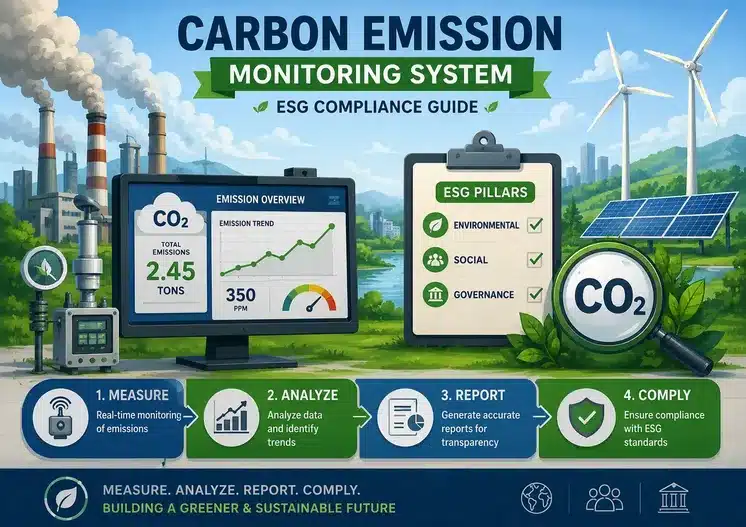
Carbon Emission Monitoring System Architecture for Manufacturers 2026
Carbon Emission Monitoring System Architecture for Manufacturers 2026
Industrial manufacturers face increasing pressure to measure, report, and reduce greenhouse gas emissions. In 2026, regulations such as the Corporate Sustainability Reporting Directive in Europe, SEC climate disclosure rules in the United States, and similar frameworks in the United Kingdom are making carbon emission monitoring a business-critical activity. Manufacturers in Germany, Netherlands, Italy, and France are investing in monitoring architectures that provide accurate, auditable emission data.
This guide explains how to design a carbon emission monitoring system. It covers data collection, calculation methodologies, system integration, reporting, and compliance considerations.
Table of Contents
- Why Carbon Monitoring Is Now Strategic
- System Architecture Overview
- Data Collection Layer
- Emission Calculation Engines
- Reporting and Dashboards
- Integration with ERP and MES
- Verification and Audit Trails
- Regional Compliance Drivers
- Implementation Roadmap
- Frequently Asked Questions
Why Carbon Monitoring Is Now Strategic
Carbon data is no longer used only for sustainability reports. It now influences capital allocation, supplier selection, product pricing, and customer relationships. Companies that cannot demonstrate emission reductions risk losing contracts, paying carbon penalties, and facing higher financing costs.
System Architecture Overview
A carbon monitoring system connects data sources, calculation engines, reporting tools, and verification workflows. The architecture must handle direct emissions from owned sources, indirect emissions from purchased energy, and value-chain emissions from suppliers and product use.
Data Collection Layer
Sensor-Based Monitoring
Continuous emissions monitoring systems measure stack gas concentrations and flow rates. They provide real-time data for large point sources such as boilers, furnaces, and chemical reactors.
Activity Data Collection
For many emission sources, activity data such as fuel consumption, electricity use, and material throughput are more practical than direct measurement. These data often come from utility meters, ERP systems, and production records.
Supplier and Logistics Data
Scope 3 emissions require data from suppliers, logistics providers, and waste handlers. Digital questionnaires, supplier portals, and lifecycle databases support this collection.
Emission Calculation Engines
Calculation engines apply emission factors to activity data according to protocols such as the GHG Protocol or ISO 14064. Engines must handle unit conversions, global warming potentials, and allocation rules for complex processes.
Reporting and Dashboards
Dashboards translate raw data into actionable insights. Manufacturing leaders track emissions intensity, progress toward targets, and variance by site or product line. Automated reports simplify submission to regulators, customers, and investors.
Integration with ERP and MES
Integrating carbon monitoring with enterprise and manufacturing systems improves accuracy and reduces manual effort. Production data from MES and procurement data from ERP feed directly into emission calculations. German manufacturers are pioneers in this system-level integration.
Verification and Audit Trails
Third-party verification builds credibility. Audit trails document data sources, calculation methods, assumptions, and changes over time. Version control and user access management prevent unauthorized modifications.
Regional Compliance Drivers
| Region | Driver | Impact |
|---|---|---|
| European Union | CSRD and EU ETS | Detailed reporting and carbon pricing |
| United States | SEC climate rules | Disclosure of material climate risks |
| United Kingdom | Streamlined Energy and Carbon Reporting | Mandatory annual reporting |
| Netherlands | CO2 performance ladder | Tender advantage for low-carbon suppliers |
Implementation Roadmap
- Define organizational boundaries and emission scopes.
- Identify data sources and establish collection procedures.
- Select calculation methodology and emission factors.
- Deploy monitoring software and integrate with existing systems.
- Validate data quality and establish audit trails.
- Report baseline and set reduction targets.
Future Trends and Regional Considerations
Blockchain for Supply Chain Transparency
Blockchain for Supply Chain Transparency represents a significant evolution in carbon emission monitoring system. Organizations that master this area can differentiate their offerings and build more resilient operations.
Organizations in the Netherlands, Italy, and France are integrating Blockchain for Supply Chain Transparency into their operations to reduce risk, lower costs, and improve outcomes. In 2026, this trend is accelerating as digital tools, tighter regulations, and customer expectations drive investment.
Satellite and Remote Sensing Validation
Satellite and Remote Sensing Validation represents a significant evolution in carbon emission monitoring system. Organizations that master this area can differentiate their offerings and build more resilient operations.
Facilities in Italy, France, and the United Kingdom demonstrate that Satellite and Remote Sensing Validation can deliver practical value in carbon emission monitoring system without requiring massive capital outlays. Scalable deployment models are helping smaller players participate.
Carbon Border Adjustment Mechanisms
The adoption of Carbon Border Adjustment Mechanisms within carbon emission monitoring system is accelerating as companies seek measurable improvements. This shift reflects broader industry pressures around cost, quality, and sustainability.
Facilities in the United States, Germany, and the United Kingdom demonstrate that Carbon Border Adjustment Mechanisms can deliver practical value in carbon emission monitoring system without requiring massive capital outlays. Scalable deployment models are helping smaller players participate.
Frequently Asked Questions
What are Scope 1, 2, and 3 emissions?
Scope 1 covers direct emissions from owned sources. Scope 2 covers indirect emissions from purchased energy. Scope 3 covers all other value-chain emissions.
Do small manufacturers need carbon monitoring?
Even small manufacturers may need carbon data to supply larger customers or comply with local reporting requirements.
How accurate does carbon monitoring need to be?
Accuracy requirements depend on the application. Regulatory reporting typically requires documented methodologies and reasonable assurance. Internal management may tolerate broader estimates initially.
What software is used for carbon monitoring?
Options range from specialized sustainability platforms to modules within ERP systems. Spreadsheet-based systems are common but harder to audit at scale.
How long does implementation take?
Basic monitoring can be established in three to six months. Enterprise-wide systems with full integration may take one to two years.
Conclusion
Carbon emission monitoring systems are becoming standard infrastructure for industrial manufacturers in 2026. A well-designed architecture provides accurate data, supports regulatory compliance, and enables informed decarbonization decisions. Companies that invest early will avoid compliance surprises and position themselves as preferred suppliers in low-carbon supply chains.
Comments (3)