UV-Vis Spectrophotometer Selection for Analytical Laboratories 2026
UV-Vis Spectrophotometer Selection for Analytical Laboratories 2026
UV-Visible spectrophotometry is one of the most widely used analytical techniques in laboratories around the world. From pharmaceutical quality control to environmental testing and food safety, UV-Vis instruments provide reliable quantitative and qualitative data. In 2026, laboratories in the United States, United Kingdom, Germany, Netherlands, Italy, and France are selecting systems that balance performance, compliance, and total cost of ownership.
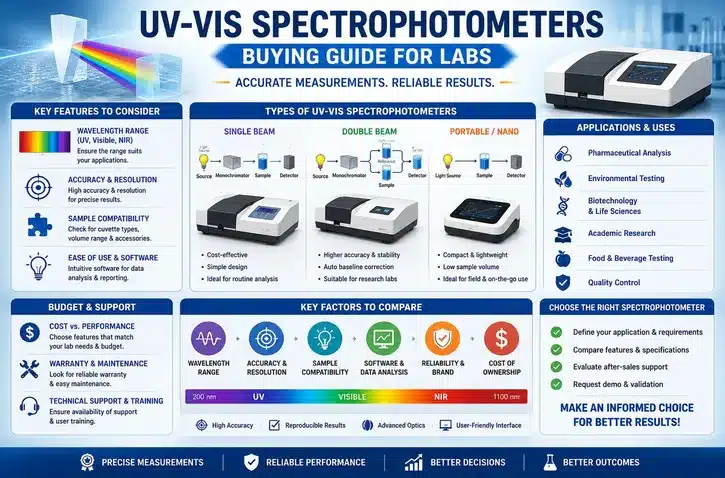
This selection guide explains the key specifications, features, and application considerations that laboratory managers should evaluate when purchasing a UV-Vis spectrophotometer.
Table of Contents
- Understanding UV-Vis Technology
- Single Beam vs Double Beam Systems
- Wavelength Range and Resolution
- Light Source and Detector Options
- Sample Handling Accessories
- Software and Data Management
- Calibration and Validation
- Application Matching
- Total Cost of Ownership
- Frequently Asked Questions
Understanding UV-Vis Technology
UV-Vis spectrophotometers measure how much light a sample absorbs across the ultraviolet and visible regions of the electromagnetic spectrum. Molecules with conjugated bonds, aromatic rings, or transition metal centers absorb strongly in these regions, enabling sensitive detection and quantification.
The technique is valued for its simplicity, speed, and broad applicability. With proper method development, a single instrument can support dozens of different assays.
Single Beam vs Double Beam Systems
Single Beam Instruments
Single beam systems measure sample and reference sequentially. They are compact, affordable, and suitable for routine analyses where high precision is not required.
Double Beam Instruments
Double beam systems split the light path to measure sample and reference simultaneously. They offer better stability and are preferred for research, method development, and regulated environments.
Wavelength Range and Resolution
Most analytical UV-Vis instruments cover 190 to 1100 nanometers. Wavelength resolution of 1 nanometer is sufficient for many applications, while high-resolution instruments provide 0.1 nanometer or better for complex spectra. Bandwidth selection affects both sensitivity and spectral detail.
Light Source and Detector Options
Deuterium and Tungsten Lamps
Traditional instruments combine a deuterium lamp for UV and a tungsten-halogen lamp for visible light. These are proven, inexpensive, and easy to replace.
Xenon Flash Lamps
Xenon flash lamps offer long life and fast measurement. They are common in high-throughput screening instruments and reduce maintenance downtime.
Photodiode Array Detectors
Photodiode array detectors capture a full spectrum in milliseconds. They enable kinetic studies and fast multi-wavelength measurements.
Sample Handling Accessories
Accessories extend instrument capability. Automated cell changers, sipper systems, microvolume holders, and solid sample accessories support diverse workflows. Temperature-controlled cell holders are essential for enzymatic and kinetic studies.
Software and Data Management
Modern UV-Vis software offers method libraries, custom reporting, and integration with LIMS. Compliance-ready software includes audit trails, electronic signatures, and user access controls for regulated laboratories.
Calibration and Validation
Routine calibration verifies wavelength accuracy, photometric accuracy, and stray light. Certified reference materials and certified filters provide traceability. Pharmaceutical laboratories follow pharmacopeial methods and good laboratory practice requirements.
Application Matching
| Application | Recommended Features |
|---|---|
| Pharmaceutical QC | Double beam, compliance software, multi-cell changer |
| Environmental testing | Broad wavelength range, sipper accessory |
| Food and beverage | Fast scanning, color analysis software |
| Research | High resolution, kinetics, temperature control |
| Teaching | Simple interface, low cost, robust design |
Total Cost of Ownership
Beyond purchase price, consider lamp replacement, calibration standards, software licensing, service contracts, and training. A low-cost instrument with expensive consumables may become more expensive over time than a higher-priced system with lower operating costs.
Future Trends and Regional Considerations
Miniaturization and Lab-on-Chip Devices
The adoption of Miniaturization and Lab-on-Chip Devices within uv vis spectrophotometer is accelerating as companies seek measurable improvements. This shift reflects broader industry pressures around cost, quality, and sustainability.
Companies in Italy, France, and the United Kingdom report meaningful gains after embedding Miniaturization and Lab-on-Chip Devices into uv vis spectrophotometer workflows. These improvements span productivity, quality, and environmental performance.
Improved Detector Technologies
Improved Detector Technologies is reshaping how organizations approach uv vis spectrophotometer. It addresses critical performance gaps while creating opportunities for efficiency, compliance, and competitive differentiation.
Markets such as the United Kingdom, the Netherlands, and Italy show strong momentum for Improved Detector Technologies adoption. Local regulations, customer requirements, and competitive pressure all contribute to this growth.
Sustainability in Laboratory Operations
Modern uv vis spectrophotometer increasingly depends on Sustainability in Laboratory Operations. The technology and practices involved are maturing rapidly, making adoption more accessible across facility sizes.
Markets such as Italy, the United States, and the United Kingdom show strong momentum for Sustainability in Laboratory Operations adoption. Local regulations, customer requirements, and competitive pressure all contribute to this growth.
Frequently Asked Questions
What is the typical price range for a UV-Vis spectrophotometer?
Entry-level single beam systems start around \$2,000. Advanced double beam research systems can cost \$30,000 to \$60,000.
How do I choose between single beam and double beam?
Choose single beam for routine, budget-sensitive work. Choose double beam for research, method development, and regulated quality control.
What cuvette material should I use?
Quartz cuvettes are required for UV below 350 nanometers. Glass or plastic cuvettes are acceptable for visible range measurements.
Can UV-Vis measure solids?
Yes, with diffuse reflectance accessories or integrating spheres. Solid sample analysis is common in coatings, films, and powders.
How often should lamps be replaced?
Deuterium lamps typically last 1,000 to 2,000 hours. Tungsten lamps last 2,000 to 4,000 hours. Actual life depends on usage and operating conditions.
Conclusion
Selecting a UV-Vis spectrophotometer requires matching technical specifications to application requirements and regulatory needs. In 2026, laboratories should evaluate optical performance, software compliance, accessory compatibility, and total cost of ownership together to make a decision that supports long-term analytical goals.
Comments (3)