Derrick System Efficiency Optimization for Offshore Rigs 2026
Derrick System Efficiency Optimization for Offshore Rigs 2026
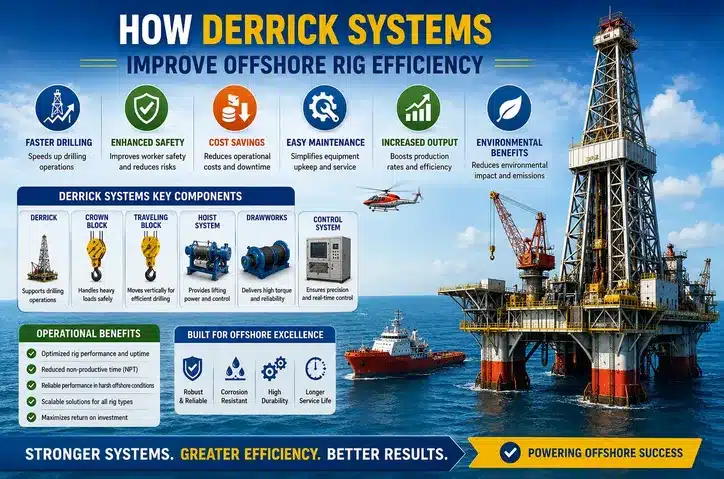
Derrick systems are the lifting backbone of offshore drilling and workover operations. Their efficiency directly affects rig productivity, fuel consumption, maintenance costs, and safety performance. In 2026, offshore operators in the North Sea, Gulf of Mexico, offshore Brazil, and Asia-Pacific are applying data analytics, automation, and predictive maintenance to optimize derrick performance.
This guide explores the factors that influence derrick system efficiency and provides practical strategies for improvement. It covers mechanical design, operational practices, maintenance regimes, and technology trends.
Table of Contents
- Factors Affecting Derrick Efficiency
- Load Management and Rigging
- Automation and Control Systems
- Maintenance and Inspection
- Crew Training and Procedures
- Energy and Power Optimization
- Data Analytics for Performance
- Safety and Downtime Reduction
- Regional Practices
- Frequently Asked Questions
Factors Affecting Derrick Efficiency
Derrick efficiency depends on mechanical condition, control logic, crew skill, environmental conditions, and maintenance discipline. Inefficient operations cause longer tripping times, higher fuel consumption, and accelerated wear on critical components such as wire ropes, sheaves, and brakes.
Load Management and Rigging
Proper Load Distribution
Centering loads and avoiding side loading reduces stress on the derrick structure and prolongs component life.
Wire Rope Management
Correct fleet angles, regular lubrication, and cut schedules extend wire rope life and prevent sudden failures.
Hook Load Monitoring
Real-time monitoring of hook load, block position, and speed enables operators to run equipment within safe and efficient envelopes.
Automation and Control Systems
Automated pipe handling, iron roughnecks, and cyberbase controls reduce manual tasks and improve consistency. Anti-collision systems prevent costly damage between moving equipment. Integrated drilling control systems optimize parameters such as weight on bit and rate of penetration.
Maintenance and Inspection
Preventive maintenance programs address wear before it causes failure. Inspections cover structural welds, sheaves, crown and traveling blocks, brake systems, and safety devices. Drone and robotic inspections are gaining popularity for hard-to-reach areas.
Crew Training and Procedures
Well-trained crews operate equipment more smoothly and respond faster to anomalies. Simulation-based training improves competence without exposing personnel to live rig hazards. Standard operating procedures ensure consistent practices across shifts.
Energy and Power Optimization
Derrick hoisting is one of the largest power consumers on a rig. Energy management systems optimize engine loading, reduce idle time, and recover braking energy where possible. Hybrid and all-electric rigs offer additional efficiency gains.
Data Analytics for Performance
Sensors on derrick components generate data on load cycles, vibration, temperature, and operating hours. Analytics platforms identify trends, predict failures, and recommend maintenance actions. Norwegian and US operators are early adopters of derrick digital twins.
Safety and Downtime Reduction
Safety and efficiency are closely linked. Incidents cause downtime, investigations, and repairs. Layered safety systems, permit-to-work procedures, and near-miss reporting create a culture that protects both people and productivity.
Regional Practices
| Region | Focus Area |
|---|---|
| North Sea | Harsh environment durability and emissions reduction |
| Gulf of Mexico | Hurricane resilience and high-efficiency tripping |
| Brazil | Deepwater load capacity and automation |
| Middle East | High-temperature operation and cost control |
Future Trends and Regional Considerations
Electrification of Rig Systems
The adoption of Electrification of Rig Systems within derrick system efficiency is accelerating as companies seek measurable improvements. This shift reflects broader industry pressures around cost, quality, and sustainability.
Companies in France, Germany, and the Netherlands report meaningful gains after embedding Electrification of Rig Systems into derrick system efficiency workflows. These improvements span productivity, quality, and environmental performance.
Remote Operations and Digital Twins
Remote Operations and Digital Twins represents a significant evolution in derrick system efficiency. Organizations that master this area can differentiate their offerings and build more resilient operations.
In the United Kingdom, the Netherlands, and Italy, engineering teams are using Remote Operations and Digital Twins to solve long-standing challenges in derrick system efficiency. The approach is gaining traction among both large enterprises and specialized suppliers.
Decommissioning and Life Extension
Decommissioning and Life Extension is reshaping how organizations approach derrick system efficiency. It addresses critical performance gaps while creating opportunities for efficiency, compliance, and competitive differentiation.
In France, Germany, and the Netherlands, engineering teams are using Decommissioning and Life Extension to solve long-standing challenges in derrick system efficiency. The approach is gaining traction among both large enterprises and specialized suppliers.
Frequently Asked Questions
What is derrick system efficiency?
It refers to how effectively the derrick and hoisting system convert energy and time into productive lifting and tripping operations.
How can derrick maintenance reduce downtime?
Preventive and predictive maintenance identify wear before failure, allowing repairs during planned maintenance windows.
What role does automation play?
Automation reduces manual handling, improves consistency, and enables data collection for optimization.
How often should derricks be inspected?
Visual and structural inspections occur regularly, with detailed surveys typically performed annually or after major events.
Can older rigs be made more efficient?
Yes. Upgrades to controls, monitoring systems, and maintenance practices can significantly improve older derrick systems.
Conclusion
Derrick system efficiency optimization requires attention to mechanical condition, operational discipline, crew competence, and modern technology. In 2026, offshore operators that combine preventive maintenance, automation, and data analytics will achieve safer, more productive, and more economical rig operations.
Comments (3)