Spectrophotometer-Based Quality Control for Manufacturing 2026
Spectrophotometer-Based Quality Control for Manufacturing 2026
Quality control in modern manufacturing depends on fast, accurate, and repeatable measurement of chemical composition, color, and physical properties. Spectrophotometers have become essential instruments in laboratories and production environments across the United States, United Kingdom, Germany, Netherlands, Italy, and France. In 2026, manufacturers are integrating spectrophotometric analysis deeper into their quality systems to reduce rework, ensure regulatory compliance, and protect brand reputation.
This guide explores how spectrophotometers support manufacturing quality control. It covers instrument types, calibration practices, integration strategies, and practical applications across industries.
Table of Contents
- Why Spectrophotometry Matters in Manufacturing QC
- Types of Spectrophotometers for Industrial Use
- UV-Vis Spectrophotometry for Chemical Analysis
- Color and Appearance Measurement
- Calibration and Method Validation
- Integration with LIMS and ERP
- Common Applications by Industry
- Maintenance and Troubleshooting
- Regulatory Compliance
- ROI and Implementation
- Frequently Asked Questions
Why Spectrophotometry Matters in Manufacturing QC
Spectrophotometry measures how light interacts with a sample. Because every material absorbs or transmits light in a unique pattern, the technique can identify substances, quantify concentrations, and detect deviations from specifications. Manufacturers use these measurements to verify incoming raw materials, monitor in-process quality, and release finished goods.
The shift toward real-time release testing and continuous manufacturing is increasing demand for fast, inline spectrophotometric methods. Plants that can verify quality without waiting for external laboratory results reduce inventory hold times and improve responsiveness.
Types of Spectrophotometers for Industrial Use
UV-Visible Spectrophotometers
UV-Vis instruments measure absorption in the ultraviolet and visible ranges. They are widely used for quantitative analysis of chemicals, dyes, coatings, and pharmaceuticals.
Near-Infrared Spectrophotometers
NIR systems are ideal for rapid, non-destructive testing of solids and slurries. Food, chemical, and polymer manufacturers use NIR for moisture, protein, fat, and additive analysis.
Color Spectrophotometers
Dedicated color measurement instruments quantify reflectance across the visible spectrum. They ensure color consistency in paints, plastics, textiles, and printed packaging.
UV-Vis Spectrophotometry for Chemical Analysis
UV-Vis analysis relies on the Beer-Lambert relationship between absorbance and concentration. Method development involves selecting the correct wavelength, preparing standards, and validating linearity. Modern instruments offer automatic wavelength scanning, multi-cell changers, and software-guided workflows that reduce operator error.
Color and Appearance Measurement
Color is a critical quality attribute for consumer products. Spectrophotometric color measurement provides objective data using color spaces such as CIELAB. Delta E values quantify color difference between batches and standards. Gloss and haze accessories extend measurement to appearance properties.
Calibration and Method Validation
Accurate spectrophotometry depends on regular calibration with certified reference materials. Wavelength accuracy, photometric accuracy, and stray light must be verified according to manufacturer and regulatory guidelines. Method validation demonstrates precision, accuracy, linearity, and robustness.
Integration with LIMS and ERP
Connecting spectrophotometers to laboratory information management systems and enterprise resource planning platforms streamlines data flow. Results transfer automatically, reducing transcription errors and accelerating release decisions. German and Dutch manufacturers are leaders in this integration.
Common Applications by Industry
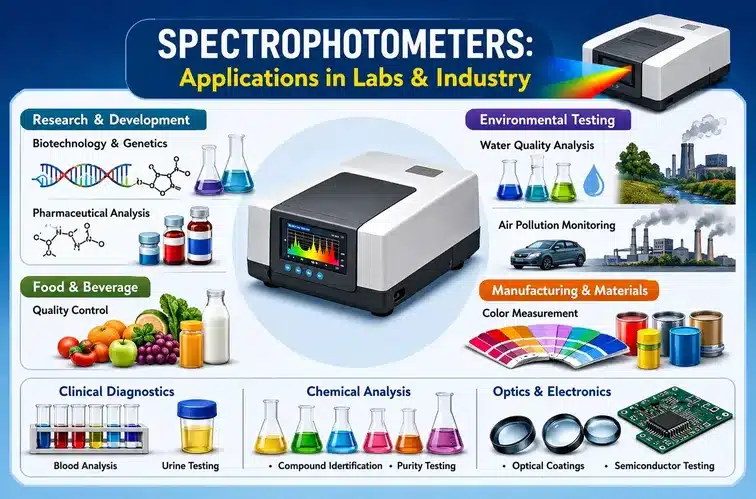
| Industry | Application | Instrument Type |
|---|---|---|
| Pharmaceuticals | Assay and dissolution testing | UV-Vis |
| Food and beverage | Moisture and composition | NIR |
| Paints and coatings | Color matching | Color spectrophotometer |
| Plastics | Additive and stabilizer analysis | NIR or UV-Vis |
| Water treatment | Contaminant detection | UV-Vis |
Maintenance and Troubleshooting
Routine maintenance includes cleaning optical surfaces, replacing lamps, checking cuvettes, and verifying calibration. Common issues such as baseline drift, noisy signals, and unexpected absorbance values often trace back to lamp aging, contaminated cells, or incorrect method settings.
Regulatory Compliance
Regulated industries must follow pharmacopeial methods, ISO standards, and good laboratory practice requirements. Audit trails, user access controls, and electronic signatures are essential features for compliance.
ROI and Implementation
Spectrophotometer investments pay back through reduced external testing, faster batch release, lower scrap, and improved customer satisfaction. A well-implemented system can eliminate recurring contract laboratory costs and provide capabilities for years.
Future Trends and Regional Considerations
Portable and Handheld Instruments
The adoption of Portable and Handheld Instruments within spectrophotometer quality control is accelerating as companies seek measurable improvements. This shift reflects broader industry pressures around cost, quality, and sustainability.
Facilities in Italy, the United States, and the United Kingdom demonstrate that Portable and Handheld Instruments can deliver practical value in spectrophotometer quality control without requiring massive capital outlays. Scalable deployment models are helping smaller players participate.
Artificial Intelligence in Spectral Analysis
The adoption of Artificial Intelligence in Spectral Analysis within spectrophotometer quality control is accelerating as companies seek measurable improvements. This shift reflects broader industry pressures around cost, quality, and sustainability.
Companies in the United States, Germany, and the United Kingdom report meaningful gains after embedding Artificial Intelligence in Spectral Analysis into spectrophotometer quality control workflows. These improvements span productivity, quality, and environmental performance.
Cloud-Based Calibration Management
Cloud-Based Calibration Management represents a significant evolution in spectrophotometer quality control. Organizations that master this area can differentiate their offerings and build more resilient operations.
Facilities in Italy, France, and the United Kingdom demonstrate that Cloud-Based Calibration Management can deliver practical value in spectrophotometer quality control without requiring massive capital outlays. Scalable deployment models are helping smaller players participate.
Frequently Asked Questions
What is a spectrophotometer used for in manufacturing?
It measures light absorption, transmission, or reflectance to identify materials, quantify concentrations, and verify color or chemical composition.
How often should a spectrophotometer be calibrated?
Calibration frequency depends on usage and regulatory requirements, but daily or weekly checks are common in manufacturing environments.
Can spectrophotometers be used inline?
Yes. Fiber-optic probes and process analyzers enable real-time spectrophotometric measurement in production lines.
What is the difference between UV-Vis and NIR?
UV-Vis measures electronic transitions in the ultraviolet and visible ranges. NIR measures molecular vibrations and is better suited for bulk material analysis.
How much does an industrial spectrophotometer cost?
Benchtop UV-Vis systems range from \$5,000 to \$30,000. Advanced process analyzers and multi-parameter systems can exceed \$100,000.
Conclusion
Spectrophotometer-based quality control gives manufacturers the speed and accuracy needed to compete in 2026. By selecting the right instrument type, validating methods, integrating with plant systems, and maintaining equipment properly, companies can turn analytical data into a reliable competitive advantage.
Comments (3)