Industrial Metrology Machine Investment Trends in Europe and America 2026
Industrial Metrology Machine Investment Trends in Europe and America 2026
Capital allocation for industrial metrology is accelerating as manufacturers seek higher first-pass yields and tighter process control. In 2026, investment decisions across the USA, UK, Germany, Netherlands, Italy, and France are increasingly influenced by automation readiness, software ecosystems, and regulatory pressures.
This market-focused guide examines where manufacturers are spending, which technologies are gaining share, and how regional differences shape metrology investment strategies.
Table of Contents
- 2026 Metrology Investment Landscape
- Technologies Attracting Capital
- Regional Investment Patterns
- ROI and Payback Expectations
- Adoption Rates by Industry
- Vendor Market Positioning
- Financing and Incentive Trends
- Future Investment Outlook
- Frequently Asked Questions
2026 Metrology Investment Landscape
Industrial metrology spending is recovering from supply-chain disruptions and is now driven by reshoring, defense spending, and clean-energy manufacturing. Companies are prioritizing systems that deliver measurable quality improvements within 24 months.
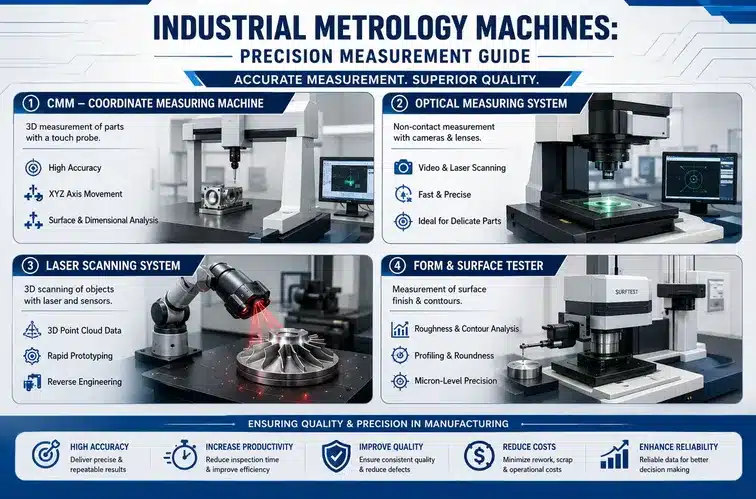
Key investment themes include inline optical inspection, robotic CMM cells, computed tomography for internal geometry, and cloud-connected quality platforms.
Drivers of Increased Spending
- Near-shoring and supply-chain resilience programs
- Electric vehicle and battery manufacturing expansion
- Stricter medical device and aerospace regulations
- Defense procurement growth in the UK, Germany, and France
- Energy transition investments in wind and hydrogen components
Technologies Attracting Capital
Optical and Vision Metrology
Optical systems are gaining share because they measure without contact and integrate easily into automated lines. Investors favor them for electronics, medical devices, and precision plastic components.
Computed Tomography Metrology
Industrial CT metrology allows internal inspection without destructive testing. Adoption is strongest in aerospace castings, additive manufacturing, and battery cell analysis.
Robotic CMM Cells
Robot-tended CMM cells reduce labor dependence and increase utilization. German automotive suppliers are leading adoption of these flexible cells.
Portable Laser Scanning
Portable laser scanners support reverse engineering and fixtureless inspection. They appeal to Italian and French mold makers and prototype shops.
Cloud Quality Platforms
Cloud-based systems centralize measurement data across multiple plants. Multinational manufacturers in the Netherlands and USA use them to standardize quality reporting.
Regional Investment Patterns
| Region | 2026 Investment Focus | Key Industries |
|---|---|---|
| USA | Automation, CT metrology, reshoring | Aerospace, defense, medical |
| UK | Compact multi-sensor systems | Precision engineering, aerospace |
| Germany | Robotic CMM cells and Industry 4.0 | Automotive, machine tools |
| Netherlands | Inline optical and semiconductor metrology | High-tech, agri-equipment |
| Italy | Flexible portable and optical systems | Machinery, molds, automotive |
| France | Large-format and aerospace-focused systems | Aerospace, energy, rail |
ROI and Payback Expectations
Scrap Reduction Value
Metrology investments often pay for themselves through scrap reduction. Plants reporting 15% to 30% scrap reductions typically achieve full payback within 18 to 30 months.
Throughput Gains
Automated inspection reduces cycle time and frees operators for value-added tasks. High-volume plants report labor efficiency gains of 10% to 25%.
Warranty and Recall Avoidance
Improved dimensional control reduces warranty claims and recall risk. Automotive suppliers calculate this risk reduction as a major component of ROI.
| Investment Range | Typical Payback | Primary Benefit |
|---|---|---|
| \$20,000 - \$75,000 | 12 - 24 months | Reduced rework and inspection time |
| \$75,000 - \$300,000 | 18 - 36 months | Scrap reduction and automation |
| \$300,000 - \$2,000,000 | 24 - 48 months | Enterprise quality integration |
Adoption Rates by Industry
Aerospace and Defense
Aerospace suppliers maintain the highest metrology investment intensity. First article inspection, CT scanning, and automated reporting are standard requirements.
Automotive and EV
Electric vehicle manufacturers invest heavily in battery metrology and motor component inspection. German and US EV suppliers are expanding CMM capacity rapidly.
Medical Devices
Medical device makers invest in non-contact optical and CT systems to inspect implants and surgical instruments without damage.
Electronics and Semiconductors
Semiconductor equipment manufacturers in the Netherlands and USA use high-precision vision systems for wafer-handling components.
Vendor Market Positioning
Carl Zeiss and Hexagon continue to dominate the high-end market. Renishaw leverages its UK base and probing expertise. Nikon Metrology and Werth focus on optical and CT niches. Wenzel and LK Metrology compete strongly on large-format and value-engineered systems.
Partnership Ecosystems
Vendors are building ecosystems with robotics integrators, software providers, and cloud platforms. Buyers increasingly evaluate these partnerships when selecting metrology partners.
Financing and Incentive Trends
Equipment Leasing
Leasing preserves cash flow and allows technology refresh cycles. It is popular among UK and Italian small and medium manufacturers.
Government Incentives
US manufacturers may access CHIPS Act and manufacturing tax credits. German companies can use KfW loans for energy-efficient and digital equipment. French plants benefit from innovation tax credits for advanced manufacturing.
Energy Efficiency Link
Some metrology investments qualify for green manufacturing incentives because they reduce rework and material waste, lowering the carbon footprint per good part.
Future Trends and Regional Considerations
Frequently Asked Questions
Which metrology technology offers the fastest ROI?
Inline optical and vision systems often deliver the fastest ROI in high-volume electronics and automotive applications due to high throughput and low labor needs.
How much are manufacturers spending on metrology in 2026?
Small shops may invest \$20,000 to \$100,000, while large aerospace or automotive plants can spend \$500,000 to \$5 million on integrated metrology cells.
What regions are investing most heavily?
Germany, the USA, and France lead in absolute spending. The Netherlands and UK show strong growth in high-tech and precision sectors.
Are government incentives available for metrology equipment?
Yes. Incentives vary by country but often include tax credits, low-interest loans, and grants for digitalization, reshoring, or green manufacturing.
How does leasing compare to purchasing?
Leasing reduces upfront capital requirements and simplifies technology upgrades. Purchasing offers lower lifetime cost for stable, long-term applications.
What role does software play in investment decisions?
Software is increasingly decisive. Buyers prioritize platforms that integrate with CAD, ERP, MES, and SPC systems while offering predictive analytics.
Is CT metrology worth the investment?
For internal geometry, porosity analysis, and additive manufacturing, CT metrology provides unique value that often justifies the higher capital cost.
Conclusion
Industrial metrology investment in 2026 is shaped by automation, regional industrial policy, and the need for traceable quality data. Manufacturers that align their spending with these trends will strengthen their competitive position in demanding global markets.
Organizations across the USA, UK, Germany, Netherlands, Italy, and France should treat metrology as a strategic investment rather than a cost center, using ROI-based selection and regional incentive programs to maximize value.
Comments (3)