Gear Grinding Machine Selection for Automotive and Aerospace Gears 2026
Gear Grinding Machine Selection for Automotive and Aerospace Gears 2026
Gear grinding remains the final precision operation for many high-performance gears. In 2026, automotive and aerospace manufacturers across the USA, UK, Germany, Netherlands, Italy, and France are selecting grinding machines based on productivity, flexibility, and quality consistency.
This selection guide compares continuous generating grinding, profile grinding, and gear honing for automotive and aerospace applications.
Table of Contents
- Gear Grinding Processes Compared
- Automotive Gear Requirements
- Aerospace Gear Requirements
- Machine Selection Criteria
- Leading Gear Grinding Suppliers
- Cost and ROI
- Frequently Asked Questions
Gear Grinding Processes Compared
| Process | Accuracy | Productivity | Best Application |
|---|---|---|---|
| Continuous generating grinding | DIN 4-6 | Very high | Automotive mass production |
| Profile grinding | DIN 2-4 | Moderate | Aerospace and large gears |
| Gear honing | DIN 5-7 | High | Final finishing after heat treat |
Automotive Gear Requirements
Automotive gears require high productivity and consistent quality. Continuous generating grinders dominate this market, producing transmission and differential gears at high volumes.
Aerospace Gear Requirements
Aerospace gears require tighter tolerances and complete traceability. Profile grinders are preferred for large, complex gears used in engines and gearboxes.
Machine Selection Criteria
- Workpiece diameter and module range
- Required accuracy grade
- Production volume
- Automation and robot integration
- Software for measurement and compensation
Leading Gear Grinding Suppliers
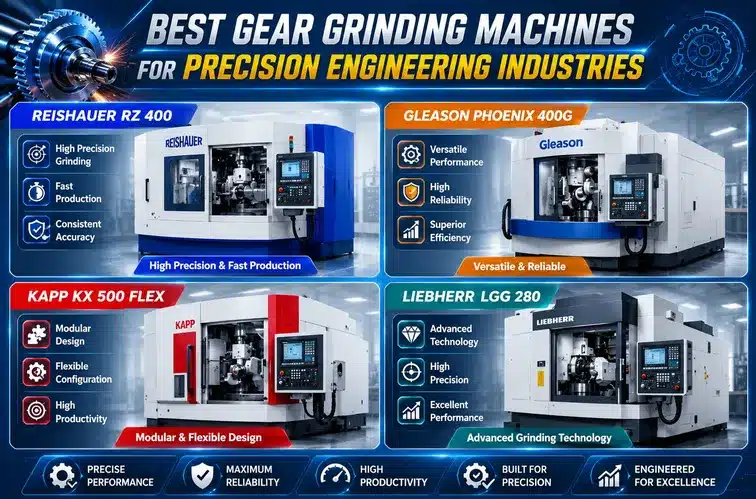
Reishauer leads in continuous generating grinding. Kapp Niles and Liebherr are strong in profile and large gear grinding. Gleason offers integrated gear manufacturing solutions. German and Swiss suppliers dominate high-end aerospace applications.
Cost and ROI
Entry-level gear grinders start around \$300,000. High-end automated systems exceed \$2 million. Automotive suppliers often achieve payback within two to three years through productivity gains.
Future Trends and Regional Considerations
Adaptive Grinding Control
The adoption of Adaptive Grinding Control within gear grinding machines is accelerating as companies seek measurable improvements. This shift reflects broader industry pressures around cost, quality, and sustainability.
Organizations in Germany, France, and the United States are integrating Adaptive Grinding Control into their operations to reduce risk, lower costs, and improve outcomes. In 2026, this trend is accelerating as digital tools, tighter regulations, and customer expectations drive investment.
Cryogenic Cooling Techniques
Cryogenic Cooling Techniques is reshaping how organizations approach gear grinding machines. It addresses critical performance gaps while creating opportunities for efficiency, compliance, and competitive differentiation.
Organizations in Italy, France, and the United Kingdom are integrating Cryogenic Cooling Techniques into their operations to reduce risk, lower costs, and improve outcomes. In 2026, this trend is accelerating as digital tools, tighter regulations, and customer expectations drive investment.
In-Process Gear Measurement
As manufacturers pursue gear grinding machines, In-Process Gear Measurement has emerged as a key enabler. It helps teams overcome traditional constraints and respond faster to changing market demands.
Companies in the United Kingdom, the Netherlands, and Italy report meaningful gains after embedding In-Process Gear Measurement into gear grinding machines workflows. These improvements span productivity, quality, and environmental performance.
Implementation and Optimization Strategies
Process Parameter Optimization
For gear grinding machines initiatives, Process Parameter Optimization should be treated as a priority rather than an afterthought. Early focus on this area builds momentum and reduces downstream risk.
In Italy, the United States, and the United Kingdom, companies that excel at gear grinding machines typically follow clear methodologies around Process Parameter Optimization. Documentation, training, and accountability are common success factors.
Coolant Management Systems
When planning gear grinding machines, leaders should allocate sufficient resources to Coolant Management Systems. This discipline separates successful deployments from those that struggle to sustain value.
Leading organizations in Germany, France, and the United States use structured approaches to Coolant Management Systems, combining technical upgrades with process discipline and workforce engagement. These integrated strategies deliver measurable results within the first year of deployment.
Wheel Dressing Schedules
Wheel Dressing Schedules plays a central role when organizations implement gear grinding machines. Neglecting this area often leads to delays, cost overruns, and underwhelming results.
In the United States, the Netherlands, and Germany, companies that excel at gear grinding machines typically follow clear methodologies around Wheel Dressing Schedules. Documentation, training, and accountability are common success factors.
Quality Sampling Plans
When planning gear grinding machines, leaders should allocate sufficient resources to Quality Sampling Plans. This discipline separates successful deployments from those that struggle to sustain value.
Practitioners in Italy, the United States, and the United Kingdom emphasize that Quality Sampling Plans works best when aligned with broader operational goals. Siloed efforts tend to underperform compared to integrated programs.
Frequently Asked Questions
What is the most productive gear grinding process?
Continuous generating grinding offers the highest productivity for mass-produced automotive gears.
Which process is best for aerospace gears?
Profile grinding delivers the accuracy and flexibility needed for aerospace gears.
How much does a gear grinding machine cost?
Prices range from \$300,000 to over \$2 million depending on size, accuracy, and automation.
Can one machine handle both automotive and aerospace?
Some flexible profile grinders can handle both, but dedicated machines usually optimize productivity for each market.
Conclusion
Selecting the right gear grinding machine requires matching process capabilities to application requirements. Automotive and aerospace manufacturers in 2026 should prioritize productivity, accuracy, and supplier support.
Comments (3)