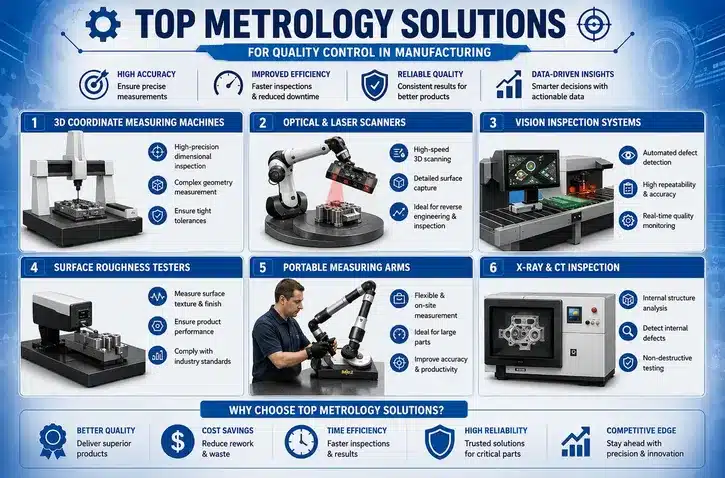
Metrology Quality Control as a Competitive Advantage in 2026
Metrology Quality Control as a Competitive Advantage in 2026
Quality control has evolved from a compliance cost into a competitive weapon. In 2026, manufacturers across the USA, UK, Germany, Netherlands, Italy, and France are using metrology quality control to win OEM contracts, reduce lead times, and charge premium prices.
This guide explores how advanced measurement capabilities create strategic advantages and how companies can build a quality-driven brand that stands out in crowded markets.
Table of Contents
- Why Quality Is Now a Competitive Advantage
- Metrology Capabilities That Differentiate
- Winning Customer Trust with Data
- Accelerating Approval Cycles
- Quality as a Premium Pricing Driver
- Attracting Talent Through Quality Culture
- KPIs That Demonstrate Quality Leadership
- Frequently Asked Questions
Why Quality Is Now a Competitive Advantage
Customers have less tolerance for defects, and OEM supply chains are consolidating around suppliers that can prove consistent performance. Metrology quality control provides the evidence needed to differentiate.
Market Pressures Driving Quality Differentiation
- Shorter product lifecycles requiring faster validation
- Increasing warranty and recall costs
- OEM consolidation toward fewer trusted suppliers
- Rising demand for traceable sustainability data
- Regulatory complexity in medical and aerospace
Metrology Capabilities That Differentiate
Sub-Micron Precision
Suppliers that can reliably measure sub-micron tolerances win business in medical implants, semiconductor equipment, and precision optics.
Internal Geometry Inspection
Industrial CT capabilities allow manufacturers to inspect hidden features without destroying parts. This capability is rare and highly valued in aerospace and additive manufacturing.
Automated Reporting
Suppliers that deliver measurement reports automatically reduce administrative friction for customers. Faster reporting shortens approval cycles and improves cash flow.
Global Data Consistency
Multinational manufacturers value suppliers that can report measurements in consistent formats across multiple plants. Cloud-connected metrology platforms enable this consistency.
| Capability | Competitive Impact | Best Suited For |
|---|---|---|
| Sub-micron CMM | Higher-value contracts | Medical and semiconductor |
| Industrial CT | Unique inspection service | Aerospace and additive |
| Automated SPC | Faster approvals | Automotive and industrial |
| Cloud reporting | Customer transparency | Multi-site OEMs |
| Fast turnaround | Shorter lead times | Job shops and prototypes |
Winning Customer Trust with Data
Traceable Measurement Records
Customers trust suppliers that can produce complete measurement histories tied to specific production lots, machines, and operators.
Shared Quality Dashboards
Some manufacturers give customers access to real-time quality dashboards. This transparency builds confidence and reduces audit burden.
Third-Party Validation
Independent calibration and measurement audits strengthen credibility. UKAS, DAkkS, and A2LA accreditations signal competence to international customers.
Accelerating Approval Cycles
First Article Inspection Automation
Automated first article inspection report generation reduces approval times from days to hours. This speed helps suppliers win prototype and low-volume production work.
Digital PPAP Packages
Automotive suppliers in Germany and the USA increasingly deliver digital production part approval packages that integrate CMM data, SPC charts, and control plans.
Reduced Customer Audits
Suppliers with robust metrology data often face fewer customer audits because customers can verify performance remotely through shared data.
Quality as a Premium Pricing Driver
Manufacturers with demonstrably lower defect rates can command higher prices. Customers often accept a 5% to 15% premium for suppliers that reduce their downstream risk.
Value-Based Pricing
Instead of competing on unit cost, quality leaders price based on total cost of ownership. Lower scrap, fewer line stoppages, and reduced inspection burden at the customer create measurable value.
Attracting Talent Through Quality Culture
Modern metrology attracts skilled engineers and technicians. Companies that invest in advanced measurement equipment and data-driven quality cultures find it easier to recruit top talent in competitive labor markets.
KPIs That Demonstrate Quality Leadership
| KPI | Industry-Leading Target | Measurement Source |
|---|---|---|
| First-pass yield | Above 98% | Production and CMM data |
| Defects per million | Below 100 | Quality management system |
| On-time delivery | Above 95% | ERP system |
| Customer complaints | Below 1 per 1,000 shipments | CRM data |
| Audit findings | Zero major findings | Certification audits |
Frequently Asked Questions
How does metrology create competitive advantage?
Metrology provides objective evidence of quality, shortens approval cycles, enables premium pricing, and builds customer trust that competitors cannot easily replicate.
Which metrology capability offers the strongest differentiation?
The answer depends on the market. Sub-micron precision differentiates medical suppliers, while CT inspection differentiates aerospace and additive manufacturers.
Can small manufacturers compete on quality?
Yes. Small shops can differentiate through fast turnaround, personalized reporting, and specialized measurement expertise in niche applications.
What data should suppliers share with customers?
Suppliers typically share measurement reports, SPC charts, certificate of conformance, and traceability records. Real-time dashboards are becoming more common.
How is quality linked to pricing power?
Suppliers with proven low defect rates and fast issue resolution can justify premium pricing because they reduce customer risk and total cost of ownership.
What role does accreditation play?
Accredited calibration and quality systems signal competence to international customers and are often required to bid on aerospace, medical, and automotive contracts.
How can manufacturers measure quality leadership?
Track first-pass yield, defects per million, customer complaints, audit findings, and on-time delivery. Benchmark against industry leaders to identify gaps.
Conclusion
Metrology quality control is no longer just a back-office function. In 2026, it is a strategic capability that wins contracts, accelerates approvals, and supports premium pricing. Manufacturers that invest in advanced measurement and data transparency will stand out in competitive global markets.
Across the USA, UK, Germany, Netherlands, Italy, and France, quality leaders are proving that precision measurement is one of the most durable competitive advantages in modern manufacturing.
Comments (3)