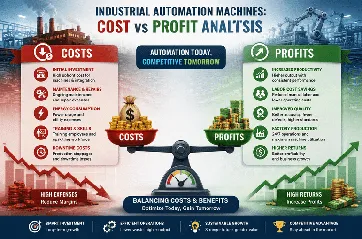
Automation ROI Analysis for Industrial Manufacturers 2026
Automation ROI Analysis for Industrial Manufacturers 2026
Industrial automation promises higher output, better quality, and lower labor costs, but these benefits only materialize when projects are justified with rigorous financial analysis. In 2026, manufacturers across the United States, United Kingdom, Germany, Netherlands, Italy, and France are sharpening their automation ROI models to satisfy finance teams, boards, and external investors.
This guide explains how to build a credible automation business case. It covers cost categories, benefit quantification, risk adjustment, and payback methods that help manufacturers make informed investment decisions.
Table of Contents
- Building the Business Case for Automation
- Cost Categories in Automation Projects
- Measuring Productivity Gains
- Quality and Scrap Reduction Benefits
- Safety and Labor Impact
- Payback and Net Present Value
- Risk Factors
- Case Examples by Region
- Implementation Best Practices
- Frequently Asked Questions
Building the Business Case for Automation
A strong automation business case starts with a clear problem statement. Whether the goal is to reduce cycle time, eliminate manual inspection, or increase capacity, the financial model must tie operational improvements to measurable business outcomes. Avoid vague claims and instead use baseline data, pilot results, and benchmarks from similar installations.
Cost Categories in Automation Projects
Equipment and Software
This includes robots, controllers, sensors, vision systems, and programming software. Equipment typically represents 40% to 60% of total project cost.
Integration and Engineering
System integrators design mechanical interfaces, electrical panels, and control logic. Engineering costs can equal or exceed equipment costs for complex applications.
Training and Change Management
Operators, maintenance staff, and engineers need training on new equipment and workflows. Change management ensures adoption and sustains benefits.
Ongoing Support and Maintenance
Annual maintenance contracts, spare parts, software licenses, and periodic upgrades must be included in lifecycle cost calculations.
Measuring Productivity Gains
Productivity gains can be measured through increased throughput, reduced cycle time, or higher machine utilization. Calculate the annual value by multiplying the additional output by contribution margin. Be conservative by assuming ramp-up periods and partial utilization during the first year.
Quality and Scrap Reduction Benefits
Automation reduces human error and process variation. Quality benefits include lower scrap rates, fewer warranty claims, reduced rework labor, and improved customer satisfaction. Some manufacturers find that quality improvements alone justify automation projects.
Safety and Labor Impact
Automating hazardous tasks reduces injury risk and associated costs. Labor benefits include redeployment of staff to higher-value roles rather than simple headcount reduction. In regions with labor shortages, automation preserves capacity.
Payback and Net Present Value
| Metric | Purpose | Typical Threshold |
|---|---|---|
| Simple payback | Time to recover initial investment | 1 to 3 years |
| Net present value | Value in today's currency | Positive NPV |
| Internal rate of return | Percentage return on investment | Above cost of capital |
| Total cost of ownership | Lifecycle cost comparison | Lower than alternative |
Risk Factors
Common risks include integration delays, lower-than-expected utilization, technology obsolescence, and maintenance skill gaps. Sensitivity analysis should test how changes in key assumptions affect ROI.
Case Examples by Region
German automotive suppliers justify automation through quality improvements and throughput gains. UK food manufacturers focus on labor savings and traceability. Dutch logistics operations automate packaging and palletizing to handle e-commerce growth. Italian machinery builders use automation to maintain export competitiveness.
Implementation Best Practices
- Start with a pilot project to validate assumptions.
- Involve finance, operations, and maintenance early.
- Use conservative benefit estimates and include all costs.
- Track actual performance against the business case.
- Plan for training and continuous improvement.
Future Trends and Regional Considerations
Subscription and Robotics-as-a-Service Models
The adoption of Subscription and Robotics-as-a-Service Models within automation cost vs profit guide is accelerating as companies seek measurable improvements. This shift reflects broader industry pressures around cost, quality, and sustainability.
Organizations in the United Kingdom, the Netherlands, and Italy are integrating Subscription and Robotics-as-a-Service Models into their operations to reduce risk, lower costs, and improve outcomes. In 2026, this trend is accelerating as digital tools, tighter regulations, and customer expectations drive investment.
Digital Twins for ROI Validation
As manufacturers pursue automation cost vs profit guide, Digital Twins for ROI Validation has emerged as a key enabler. It helps teams overcome traditional constraints and respond faster to changing market demands.
Organizations in Italy, France, and the United Kingdom are integrating Digital Twins for ROI Validation into their operations to reduce risk, lower costs, and improve outcomes. In 2026, this trend is accelerating as digital tools, tighter regulations, and customer expectations drive investment.
Reshoring and Nearshoring Drivers
Modern automation cost vs profit guide increasingly depends on Reshoring and Nearshoring Drivers. The technology and practices involved are maturing rapidly, making adoption more accessible across facility sizes.
In the United States, the Netherlands, and Germany, engineering teams are using Reshoring and Nearshoring Drivers to solve long-standing challenges in automation cost vs profit guide. The approach is gaining traction among both large enterprises and specialized suppliers.
Frequently Asked Questions
What is a good payback period for automation?
Payback periods of one to three years are common for industrial automation projects, though strategic projects with longer benefits may justify longer timelines.
How do you calculate automation ROI?
Subtract total project costs from quantified benefits over a defined period, then divide by total costs. Discounted methods such as NPV provide a more accurate picture.
Should intangible benefits be included?
Intangible benefits such as safety and flexibility should be described but quantified conservatively. A separate qualitative discussion can complement financial metrics.
What is the biggest mistake in automation ROI?
The biggest mistake is underestimating integration, training, and ongoing support costs while overestimating utilization and benefits.
How do you sustain automation benefits?
Sustain benefits through preventive maintenance, operator training, performance monitoring, and continuous improvement programs.
Conclusion
Automation ROI analysis is essential for making sound investment decisions in 2026. By capturing all costs, quantifying benefits realistically, and accounting for risk, manufacturers can build business cases that withstand scrutiny and deliver sustainable value.
Comments (3)